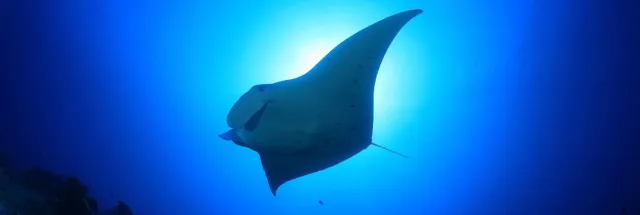
Considered as the third largest fish in the world, manta rays are large cartilaginous fish that inhabits most of the globe’s tropical waters. Having flexible cartilage instead of stiff bones, manta’s swims and glides gracefully in the water where they are often found in areas with moderate to strong water current.
Contrary to the fact that they are a close relative of the sharks which are highly carnivorous, mantas rays, on the other hand, feed on by filtering the water for small creatures like plankton. They are considered as passive feeders where they do not actively hunt for food. Instead, all they need to do is open their mouth and let the water come in where food is filtered out in the gills which is pretty much the same a whaleshark does. Due to their relative huge size, remoras are often attached to their bodies where they get a free meal out of the parasites found in the mantas body.
Species of Manta Rays in Cocos Island
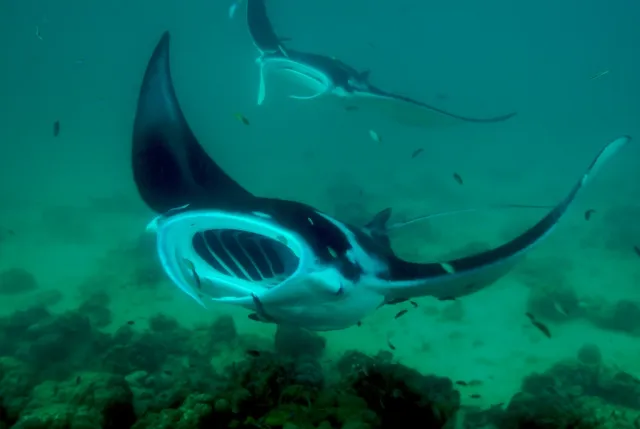
In general, there are 2 types of manta rays: the true manta rays and the mobula rays. Although they have several differences in terms of body color and size, the main difference between the 2 types can be found in the positioning of its mouth.
Manta rays have a terminal mouth where the upper and lower jaw is almost aligned and can be found right infront of the head in between the horns. On the other hand, mobula rays have a sub-terminal mouth where the upper jaw is protruding out than the lower jaw and can be found on the underside of its head.
Giant Manta Ray (Manta birostris)
- Max. Length
- 910 centimeters
- Length at 1st Maturity
- 377 centimeters
- Depth Range
- 0 – 120 meters (0 – 400 feet)
- Frequency
- Abundant in the world’s warm waters
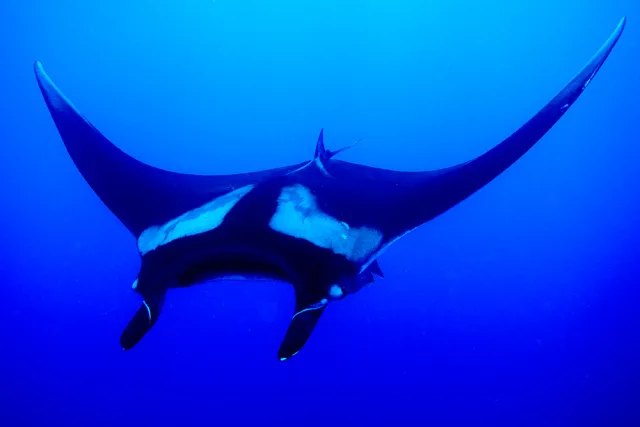
Considered as the third largest fish in the world, manta rays can grow to a relatively huge size with wingspan reaching up to 9 meters and weighs about 1.3 tons. Aside from the size, you can easily identify them through their flattened bodies with large pectoral fins that are triangular in shape. Their heads are widely broad where their is a distinct horn-like extensions called cephalic lobe that leads plankton-rich water into its terminal mouth.
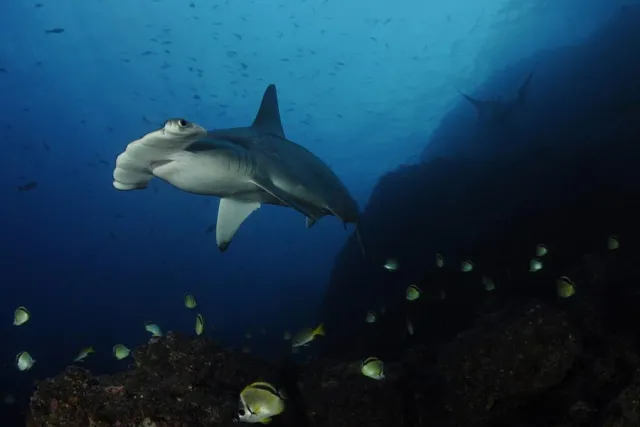
In most instances, the swimming direction of mantas are similar to a hammerhead shark where both species are often seen swimming against the current. You can also see manta rays in cleaning stations where they drop by allowing cleanerfish to do its job while taking in a free meal courtesy from its parasites and dead skin from the mantas body.
For more information, you can read our related article about giant manta rays.
Munk’s Devil Ray (Mobula munkiana)
- Max. Length
- 220 centimeters
- Length at 1st Maturity
- 107.5 centimeters
- Depth Range
- 0 – 30 meters (0 – 100 feet)
- Frequency
- Abundant in the world’s warm waters
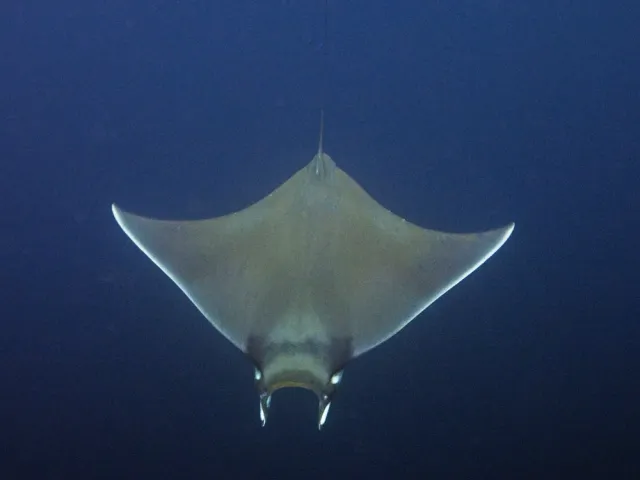
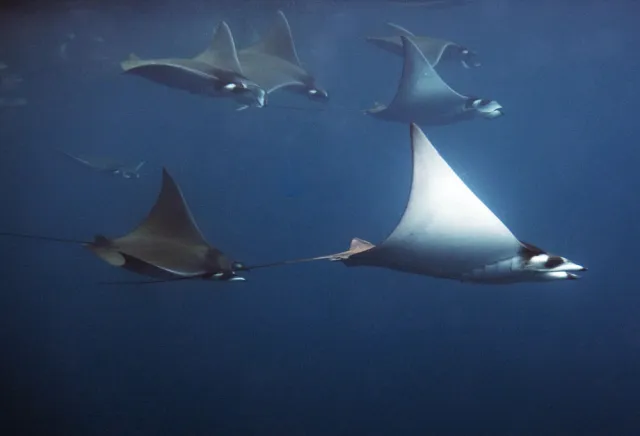
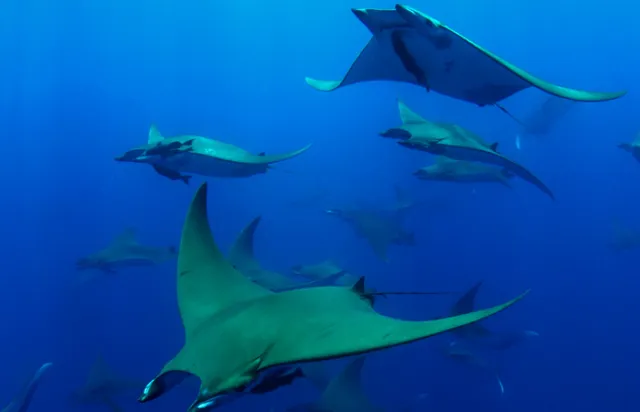
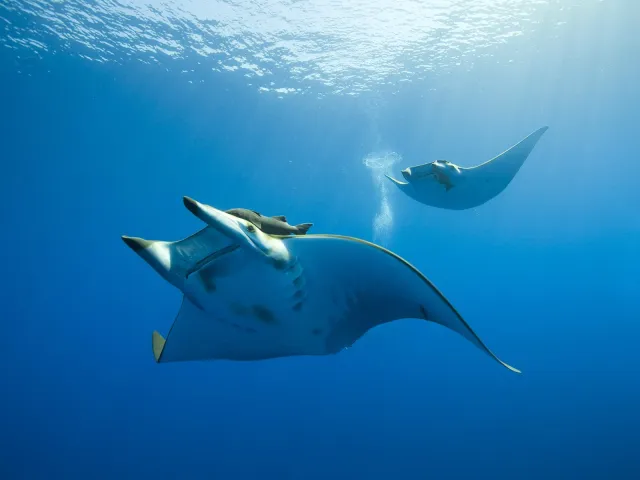
Relatively small compared to a giant manta ray, a munk’s devil ray is a small-sized manta where you can often see them in Cocos island aggregating in groups of hundreds. Although they can be commonly found at shallow depths, they inhabit the outer ledges of the reef where most of them occupies the open water environment. Aside from being underwater, you can also see a munk’s devil ray leaping out of the water during one of your boat rides around the island.
Aside from its flat body and horns in its head, you can easily identify a munk’s devil ray through its bulging eyes located on the side of the head, pectoral fins that are pointed and mouth that are sub-terminal found near the belly. They have an upper body color ranging from lavender to grey while the underside is colored white. When they are swimming and flapping their wings, the mixture of their body color will create a white margin lining on the side of its body where you clearly notice it if you are above the animal.
For more information, you can read our related article about munk’s devil ray.
Chilean Devil Ray (Mobula tarapacana)
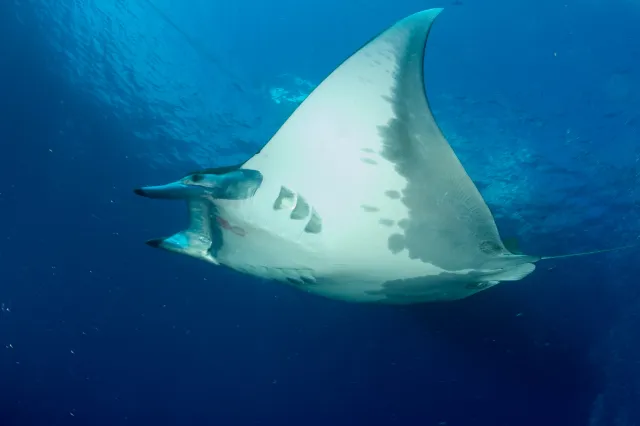
- Other Names
- Sicklefin Devil Ray and Spiny Mobula
- Max. Length
- 328 centimeters
- Length at 1st Maturity
- 153 centimeters
- Depth Range
- 0 – 30 meters (0 – 100 feet)
- Frequency
- Abundant in the world’s warm waters
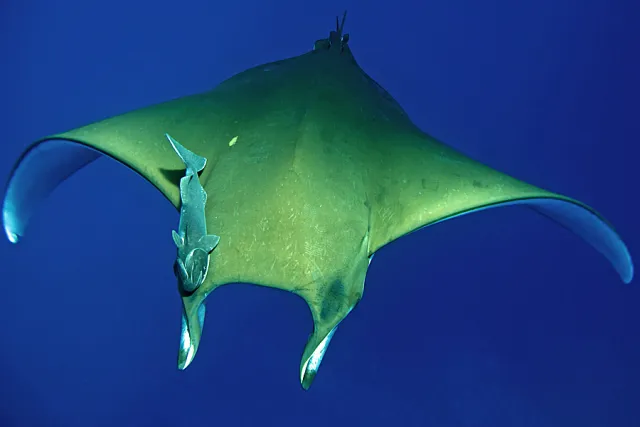
Named after a Province in Chile where it was first found, a Chilean Devil ray is a medium-sized manta where you can easily identify them through its long head that has short horns, a highly curved pectoral wings and a sub-terminal mouth.
During your underwater adventures in Cocos Island, if you are able to touch the skin of a Chilean devil ray, you will notice that its skin resembles like a sand paper. This is due to the small and fine scales called denticles that are scattered around its body.
For more information, you can read our related article about Chilean devil ray.
Horns that Lead in Food
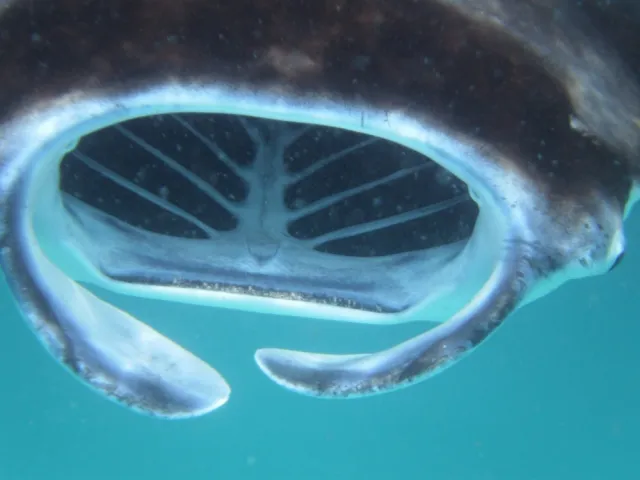
Technically termed as the cephalic lobe, the pair of horns in a mantas head are actually extensions of their pectoral wings. The mere position of the horns will tell you what the manta is doing.
When the horns are furled in, it means that the manta is just swimming and passing by. When the horns are unfurled and curved in, this is usually accompanied with the opening of its mouth where the horns lead the water to its mouth where it filters out its favorite meal which is composed primarily of tiny creatures called planktion.
Fingerprints in their Belly
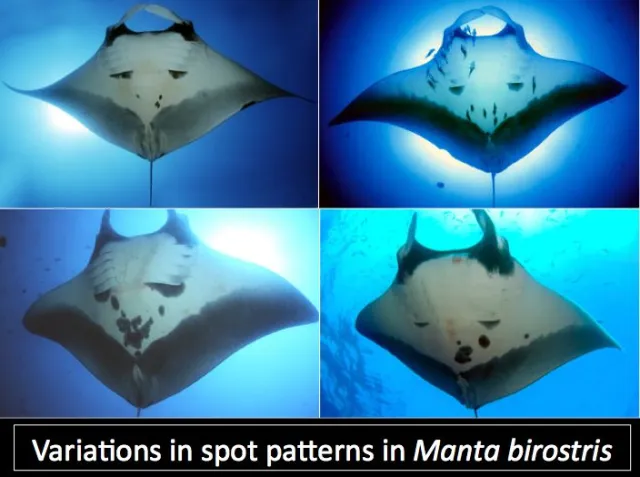
Most of your interaction with mantas in Cocos Island happens when you position yourself near the near reef where they glide over you giving you a good view of their belly and the rest of their underside.
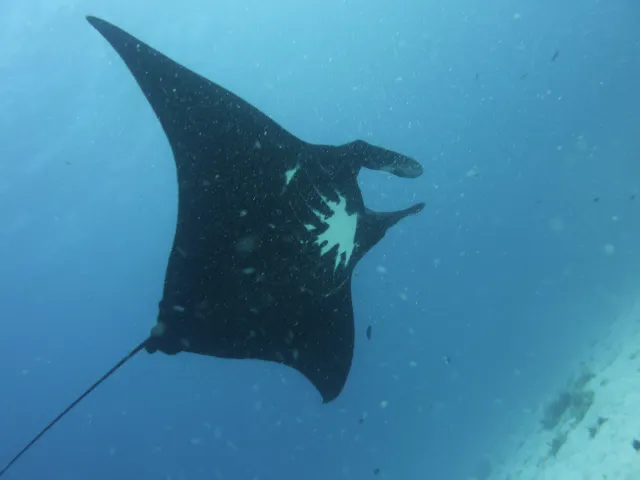
You will notice that their bellies are dotted with black spots or white markings wherein each individual has its own and unique markings. Study shows that these markings are comparable to a human fingerprint and naming a particular manta based on the distinct marking has become a global craze. For example in Australia, they were able to identify a melanistic male manta and named it Taurus. This black bellied manta ray has a unique white minimal marking on its belly. Taurus is often seen in a popular island in the eastern side of Australia where it has become a celebrity for underwater explorers.
Now, as far as Cocos Island is concerned, there is no manta yet to be named based on its belly markings. So, on your future dives in Cocos Island, don’t forget to bring your underwater camera and let its lens go to work by taking pictures of manta’s belly. Who knows, you might establish a distinct pattern and become the first person to name a manta in Cocos Island.
Reference
Fishbase: www.fishbase.org
IUCN Redlist of Threatened Species: www.iucnredlist.org
World Register of Marine Species: www.marinespeices.org
Video courtesy from alexdeep69