Chilean Devil Ray (Mobula tarapacana)
- Other Names
- Sicklefin Devil Ray and Spiny Mobula
- Max. Length
- 328 centimeters
- Length at 1st Maturity
- 153 centimeters
- Depth Range
- 0 – 30 meters (0 – 100 feet)
- Frequency
- Abundant in the world’s warm waters
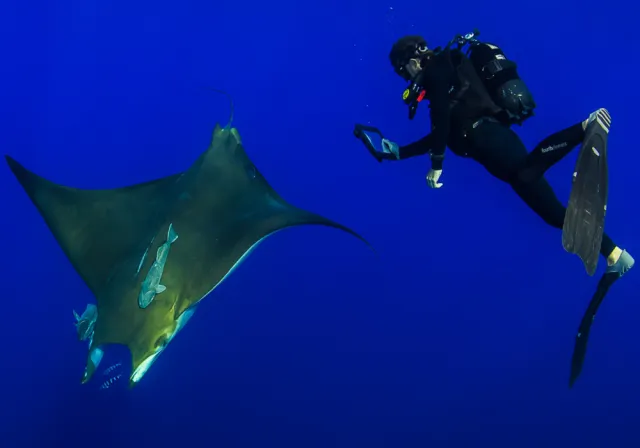
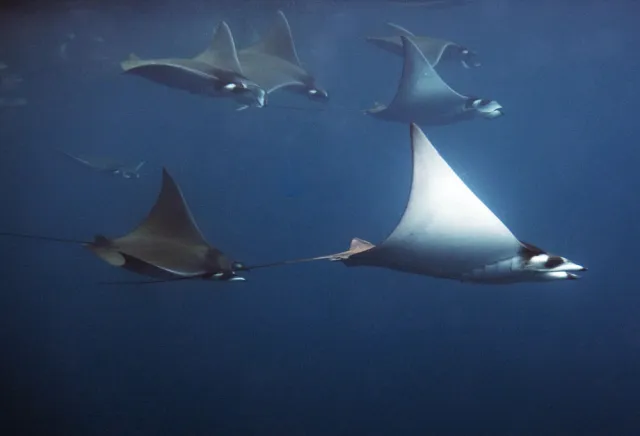
Chilean devil rays is one of the ray species in Cocos Island that converge in huge numbers. The name of this medium-sized ray was derived from a Province in Chile were it was first found and described as having a long head that has short horns, a highly curved pectoral wings and a sub-terminal mouth.
Although they are a tropical species, they mostly inhabit the outer open water areas of a reef, where in most instances during your dives in Cocos Island, can be seen during ascent or safety stop. It may become curious to our presence and may come near close to us. If you are able to touch its skin, you will notice that it is comparable to a sand paper due to the small and fine scales called denticles that are scattered around its body.
Difference between a Giant Manta Ray
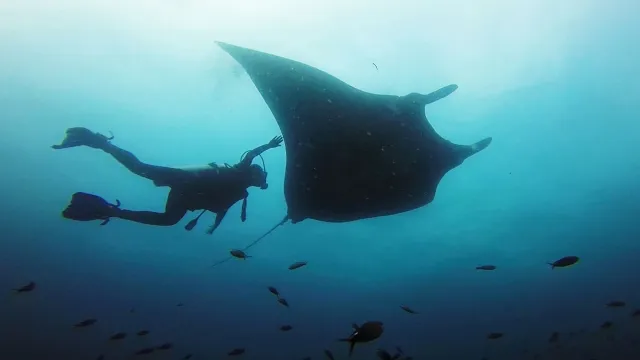
Although Mobulas and Mantas belong to the same sub-family of Mobulinae, they exhibit several differences. For a layman’s eye they may be the same, but for a trained eye a lot of differences can be spotted.
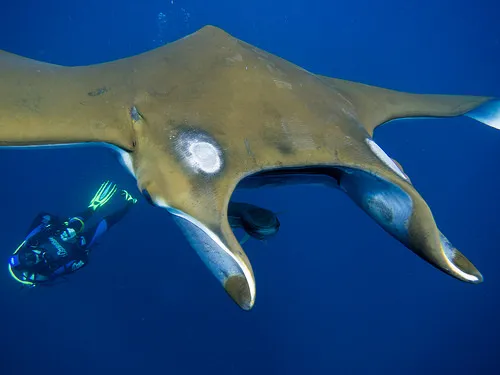
For example, mantas generally has a black-colored body while a Chilean devil ray is colored olive-green to brown. In terms of head size, mantas are broad with long horns while a Chilean devil ray is narrow and elongated with horns that are short.
But what really stands out between their differences is the positioning of the mouth. Just remember this: if the mouth is terminally located (meaning, it is directly right infront of the head), then it is a giant manta ray. If the mouth is located underneath near the belly (sub-terminal position), then it is a mobula ray.
Breaching Abilities
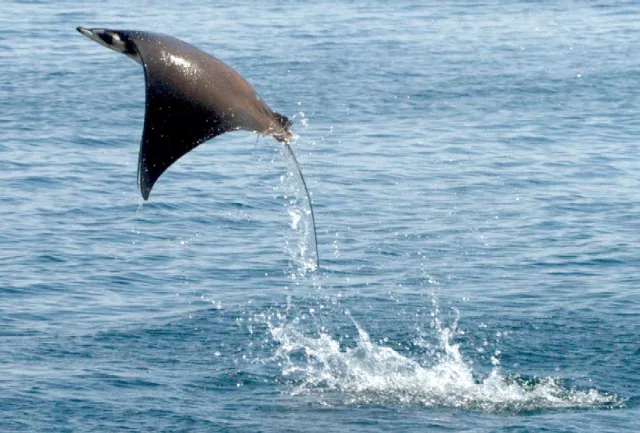
Similar to its close relative the Munk’s Devil Ray, a Chilean Devil ray has the ability to leap out of the water. In Cocos island, you may see them in groups simultaneously leaping and jumping out of the water.
Scientist hypothesized several reasons for this breaching. One study show that this habit usually occurs during mating season and could be a way to attract a mate. Some studies also suggest that this could be a mechanism to get rid of parasites clinging to their skin. There is even one video-document showing that they follow the trail of a sardine bait ball where this group of prey usually follows a path of plankton rich water which is both their main food.
Book or inquire
Reference
Fishbase: www.fishbase.org
IUCN Redlist of Threatened Species: www.iucnredlist.org
World Register of Marine Species: www.marinespecies.org
Video courtesy from ZoologicalServices