Common Guitarfish (Rhinobatos rhinobatos)
- Max. Length
- 147 centimeters
- Length at 1st Maturity
- 75 centimeters
- Depth Range
- 1 – 100 meters (3 – 300 feet)
- Frequency
- Abundant in warm waters of the Indo-Pacific Ocean
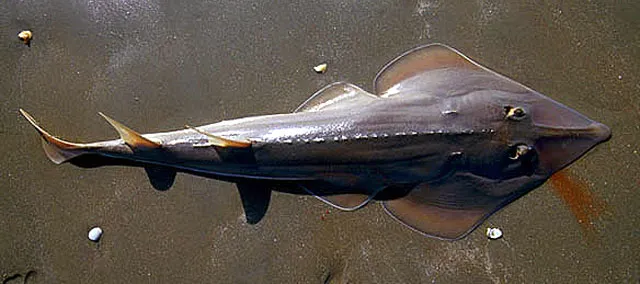
Closely related to sharks, the common guitarfish are members of the cartilaginous fish group where their skeletal structure is made up of cartilage instead of bones. During your underwater adventures in Cocos Island, you can easily see a guitarfish lying motionless or swimming close to the sand. In some instances, you can see them hiding under the sand in a camouflage position.
As their name suggest, they have a body and a triangular shaped head which closely looks like a guitar. Aside from their body shape, you can easily identify a common guitarfish through their khaki-colored body and a head that has large eyes and a large nasal lobe where the rostral ridges are widely separated.
Harmless unlike its Stingray relatives
Although a common guitarfish is closely related to a stingray, they do not pose an immediate threat to humans. While stingrays can inflict traumatogenic wounds when provoked or accidentally stepped on, guitarfish does not pose this particular danger.
The reason behind this is that guitarfish do not have sharp spines called barbels which are often found at the tail portion. But this does not mean that you can directly touch a guitarfish. You should be aware that they still have spines and thorns that are relatively small in size but can still possibly inflict wounds to your skin.
An Endangered Species
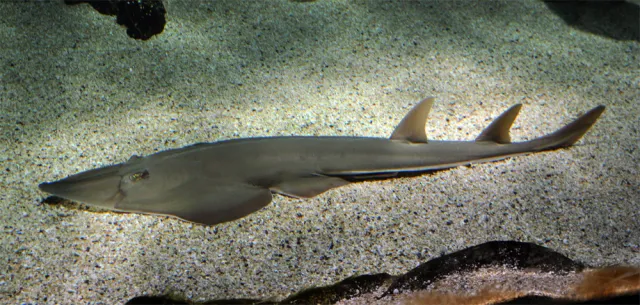
The International Union for Conservation of Nature (IUCN) has listed the Common Guiterfish under the endangered species category where their population has significantly declined over the past years.
The first reason behind their population decline has something to do with their behavior and the existence of commercial fishing activities. Guitarfish are slow-moving creatures that often inhabits sandy areas near a reef system where commercial fishing activities, like drag net and bottom trawl, are operating.
The second reason has something to do with reproduction. While a gestating female guitarfish can give birth of up to 30 pups a year, it cannot replenish the population loss brought about by commercial fishing. What is worst is that it would take at least 8 years for a juvenile guitarfish to reach maturity.
At the end of the day, when you see a guitarfish in Cocos Island do not touch it even if you already know that it has no spines that can possibly inflict wounds or perhaps hold and strum it like your typical guitar instrument.
Reference
Fishbase: www.fishbase.org
IUCN Redlist of Threatened Species: www.iucnredlist.org
World Register of Marine Species: www.marinespecies.org
https://www.youtube.com/watch?v=CHgMU7P_Zt8
Video courtesy from Yappey Calo