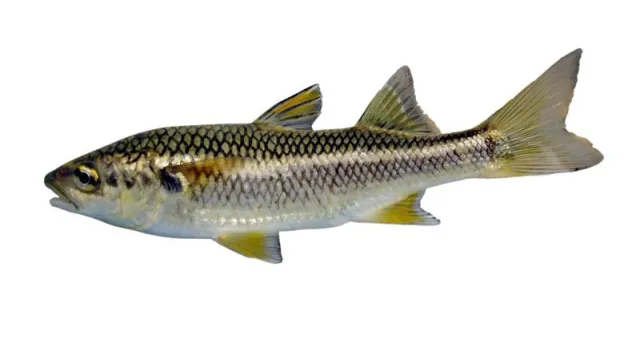
White Mullet (Mugil curema)
- Other names
- Silver Mullet and Blueback Mullet
- Max. Length
- 90 centimeters
- Length at 1st Maturity
- 25.8 centimeters
- Depth Range
- 0 – 300 meters (0 – 1,000 feet) but usually at 20 meters (60 feet)
- Frequency
- Abundant in shallow freshwater environments
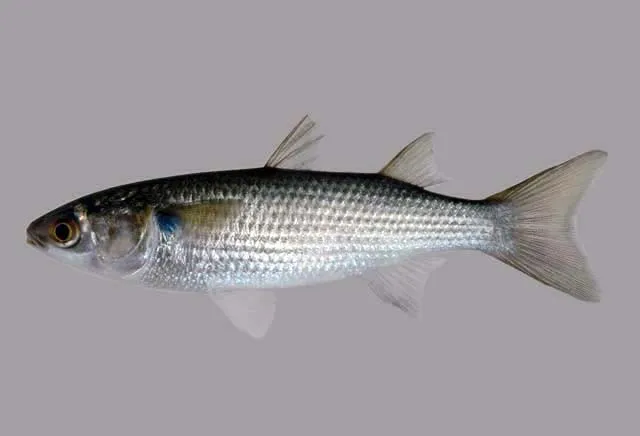
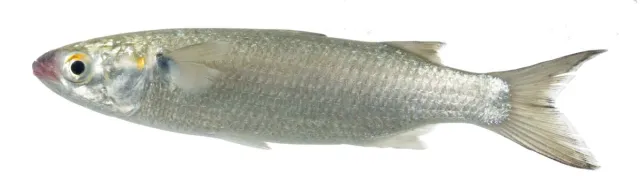
A white mullet can easily be identified since they are one of the larger fish species occupying the upper portions of a freshwater ecosystem. Aside from knowing their primary habitat, you can easily identify a white mullet through their stout body with a broad head and a terminal mouth that has thick lips which is considered one of the thickest in the Mullet family. Their body is densely covered with scales that can go up the base of all of its fins.
Expounding more on its habitat, white mullets thrive the upper portions of a freshwater ecosystem, where in the case of Cocos island, are represented by streams and rivers. During one of your hiking visits in the island, you will see that white mullets usually take shelter on the sides of a fast moving river. That is the usual routine for white mullets, but when spawning time sets in, they shift from a gentle moving species to a fast-paced fish.
Behaves like Salmon, but on the opposite end
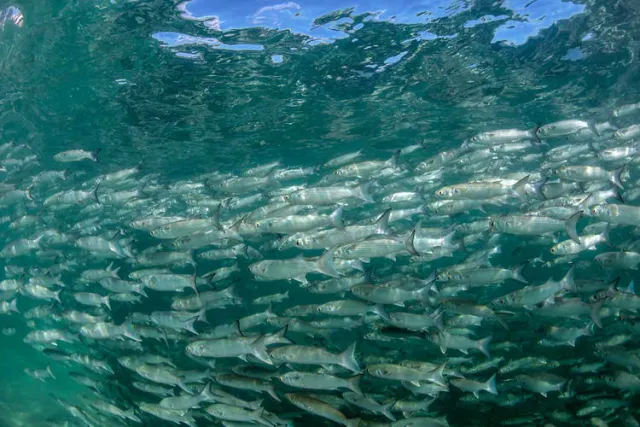
If we are going to compare a white mullet to your regular salmon, they are the same in terms of spawning behavior where both species migrate to different location and lay-out their eggs. But the direction of their migration greatly differs where salmon goes upstream (anadromic migration) while mullets goes downstream (catadromic migration). Similar to mountain mullets, the arrival of spawning season triggers the convergence of white mullets simultaneously swimming downstream.
Upon reaching the salt waters of a marine environment, white mullets will further go out at sea where you can occasionally see them during diving at 20 meters (60 feet) deep. There, they will simultaneously release their eggs turning the water into a cloud or milk color. The release of millions of eggs means an instant meal for small fish where a calm reef will immediately convert into a feeding frenzy mode for small reef fish.
Of course, not all eggs are consumed by small fish and their surviving juvenile will move to a shallow and sheltered environment. Some have said that they have seen both adults and juveniles occupying the shallow waters near the shores of Cocos island.
Eats Mud rather than Hamburgers
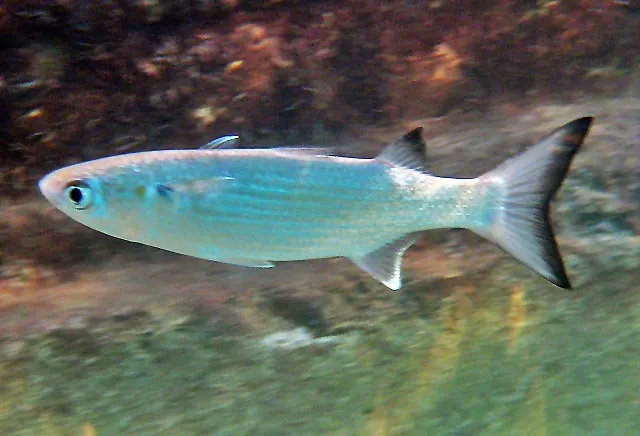
Who doesn’t love hamburgers? Most of us do, including children, teenagers, adults and our senior citizens. But white mullets prefer feasting on mud rather than eating food that is highly loaded with calories, grease and trans fat. While, for us, it may be disgusting to eat mud. However, what we do not know is that mud contains all sorts of organic matter making it an excellent source of nourishment for fish in general.
White mullet does not just eat regular mud. It prefers the mud found in river mouth where it may contain other substances like algae, plankton, detritus and other organic matter. This organic-rich mud enables a white mullet to grow rapidly where they can reach a maximum size of 90 centimeters.
Knowing all these facts, would you still eat hamburgers or shift your gastronomic nourishment in to a mud-based diet? Well, we know that it is not possible for humans, but other uses of mud in humans are starting to grow where it is now considered an excellent rejuvenating agent for your skin. And lastly, kidding aside, the reason white mullets does not prefer hamburgers is due to the fact that there are no fast-food chains in Cocos island.
Reference
Fishbase: www.fishbase.org
IUCN Redlist of Threatened Species: www.iucnredlist.org
Discover Life: www.discoverlife.org
Video courtesy from thedeepbluecolor