Roundel Batfish (Zalieutes elater)
- Max. Length
- 15 centimeters
- Length at 1st Maturity
- 9.5 centimeters
- Depth Range
- 18 – 113 meters (60 – 370 feet)
- Frequency
- Abundant in the deep waters of the Eastern Pacific Ocean
There will come a point, during your underwater adventures in Cocos island, that you will arrive and visit one of the sandy areas or muddy bottom where you can see an oddly-looking fish: the Roundel Batfish. This fish can easily be identified through its disc-shaped brown colored body that is more or less triangular in shape. Further, it has a pseudo-eye that is colored bright orange located just above their true eyes. Despite their heads being depressed, which is considered as a disadvantageous characteristic, this is compensated with a highly developed small cavity in the head that extends outward like a projectile and primarily acts as a lure to catch food.
Walks on the Floor
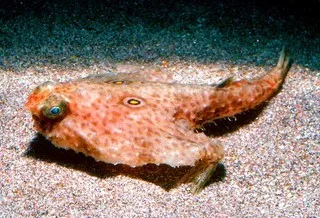
Do you believe that a roundel batfish prefers to walk rather than swim as its primary means of locomotion? Yes, it is true. But how?
In general for an animal to walk, it must have a pair of legs. In the case of a roundel batfish which has a flat body orientation, their pair of pectoral fins has evolved in to arm like extension that closely resembles like a leg. But this does not mean that a roundel batfish does not swim anymore. They still do.
Your typical interaction with a roundel batfish in Cocos island starts by observing them lying motionless in the sandy bottom. You will see that they are using their so-called legs for short distance walking. But as your interest in this oddly-looking fish starts to grow while coming closer to them, the fish will be threatened by your near presence and may start swimming away from you. Usually in this instance, the direction of their movement goes towards the deeper portion of the sandy seafloor.
Allergic to Lipstick but loves Eyebrows
Technically they’re not allergic. But if you try to compare a Roundel Batfish to its close cousin, the Rosy-lipped batfish, you will see that their lips are quite pale as compared to a bright red undertone. But this does not mean that their facial feature is downgraded to a minimum and can be considered an ugly-looking fish. In terms of facial beauty, while their lips are pale, this upper aesthetic value is being compensated with a brightly-colored eyebrows.
In the world of humans, beautiful eyebrows can become a means to attract mate. But in the world where roundel batfish lives, it is a defense mechanism where this so-called eyebrows acts as a pseudo-eye. This facial decoy is a great means for a roundel batfish against an attack from a predator where it could mean death, if it targets the true eye, or life if it has been persuaded with their eyebrows.
Reference:
Fishbase: www.fishbase.org
IUCN Redlist of Threatened Species: www.iucnredlist.org
Encyclopedia of Life: www.eol.org