Marble Rays (Taeniurops meyeni)
- Other Common Name
- Round Ribbontail Ray
- Old Scientific Name
- Taeniura meyeni
- Max. Length
- 330 centimeters
- Length at 1st Maturity
- 153.8
- Weight
- 150 kilograms
- Depth Range
- 1 – 500 meters (2 – 1,650 feet)
- Frequency
- Vulnerable due to Fisheries by-catch
Although marble rays can be found all over the Indo-Pacific Ocean, their huge population can be found in offshore places like Cocos island where they tend to congregate in shallow lagoons and outer reef slopes.
Matthew Meier PhotoShelter
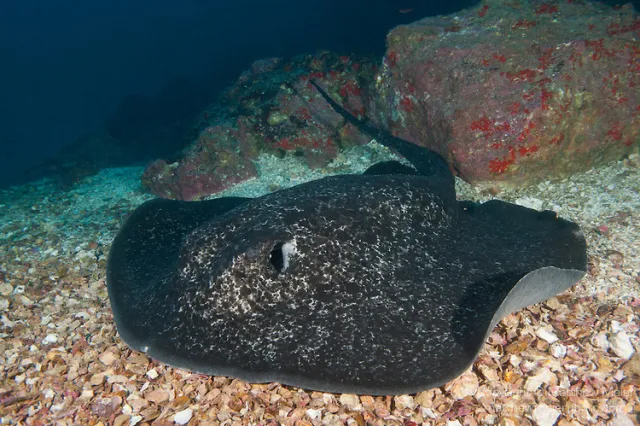
Usually found from depths ranging from 20 – 60 meters (66 – 200 feet), you can easily identify a marble ray through its large circular body that has a black and white mottled surface, a thick and rounded pectoral fin disc that are covered with tubercles and a short tail with a prominent deep ventral skin that extends up to the tip of their tail.
During the day, marble rays are often motionless where you can find them at the reef bottom usually near a vertical structure like caves and ledges. But it is a different scenario for them during night time where they are highly active to feed on bivalves, crabs and shrimps courtesy of their sub-terminal mouth. During feeding, you will notice that it has a unique body posture. Instead of lying flat on the reef bottom, it presses the outer edges of its body to the ground making its central body lifted then taking in water through its spiracle making a suction effect where their prey is revealed out of their sandy hiding place.
Interact with Caution
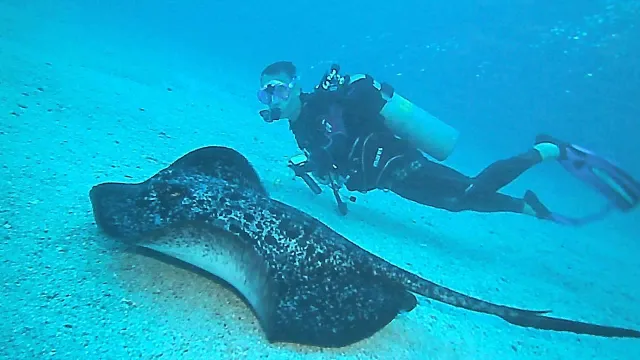
It is a common knowledge that marble rays are generally harmless to humans. In fact, it may present itself for a belly rub where it has become a popular diving experience offered in some of the world’s top diving destination.
But if you provoke a marble ray, especially when it is sleeping while lying motionless in the reef bottom, it will give you a surprise defensive maneuver by whipping its venomous tail spine which can inflict you with severe wounds. When threatened, it raises its tail over its body which allows their spine to get into position for an attack. This position is pretty much identical with the raising and gentle whipping of a dog’s tail, but rather signals the opposite behavior.
Some divers who are naughty enough to provoke this supposedly gentle species ended up with a punctured wet suit where some are unfortunate enough to suffer fatal wounds. If you are lucky to be alive, you should threat your wounds for possible bacterial infection where a marble ray’s spine is known to carry parasites and nematodes.
A By-Catch from Illegal Fishing
Reports have been made that one of the species confiscated from illegal poachers in Cocos Island are marble rays. Although they are not highly priced for their fins, their meat is highly preferred by locales where they can easily cook it giving you this soft mouth watery texture courtesy from its cartilage.
While illegal poachers are only hunting sharks which they are only after the fins, what they do not know is that the feeding habits of some shark species and marble rays are pretty much the same. So, when the poaching of sharks in Cocos Island continues, the by-catching of marble rays will also continue to exist.
Reference
Fishbase: www.fishbase.org
IUCN Redlist of Threatened Species: www.iucnredlist.org
Wikipedia: en.wikipedia.org
Video courtesy from wongcpa8