White-spotted Boxfish (Ostracion meleagris)
- Max. Length
- 25 centimeters
- Length at 1st Maturity
- 15.7 centimeters
- Depth Range
- 1 – 30 meters (3 – 100 feet)
- Frequency
- Abundant in Indo-Pacific Ocean
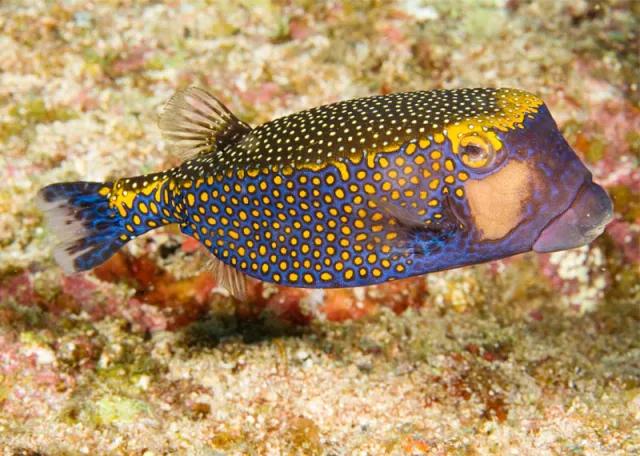
Among the 300 plus species of fish found in Cocos Island, the boxfish is one of the oddly looking sea creature where its body has a box-shape rather than the usual compressed type. Aside from its box-shaped body, you can easily identify a white-spotted boxfish through its several and small white spots on it body.
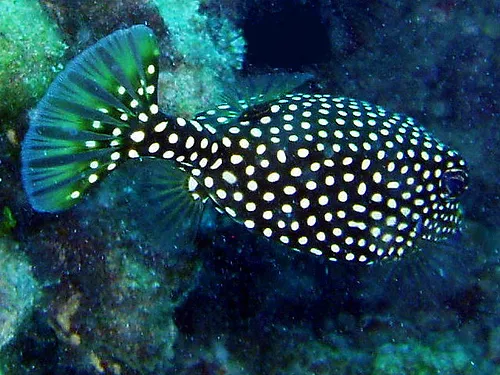
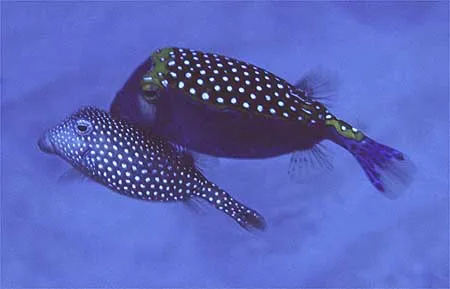
But these markings may differ from male to a female specimen. While a female white-spotted boxfish has a pre-dominantly black body with white spots scattered all over, the males white spots can only be found in the upper body where other color spots can be found especially on the ventral side of the body. Usually the spots in male include an orange circular band where studies shows that the more pronounced these orange spots, the more easy they can get a mating partner. Can you imagine this with humans? And now you know the reason why some men wear polka dots.
A Box Full of Toxins
As a general rule in the sea, oddly looking creatures usually carry toxins for protection. Well, this is true for white-spotted boxfish. Tracing back on how it nourishes its body, a white-spotted boxfish feeds on venomous tunicates, polychaetes, sponges and mollusks where the consumed toxins are accumulated in its body.
In the event that a white-spotted boxfish is threatened, stressed or injured, it releases out a poisonous mucous called ostracitoxin to deter nearby predators from coming near. But as the mucous is carried away due to water movement, any fish who consumes the mucous can be poisoned from this deadly potion.
With this, despite its popularity as an aquarium fish, raising a white-spotted boxfish indoor is quite difficult. Having this information, we highly discourage you to set-up a saltwater aquarium featuring a white-spotted boxfish as other inhabitants can easily be poisoned from its mucous. Instead, we suggest you observe them in the wild where you can find them in several dive spots around Cocos Island.
Reference
Fishbase: www.fishbase.org
Encyclopedia of Life: www.eol.org
Blue Zoo Aquatics: www.bluezooaquatics.com
Video courtesy from Taeyoung Lee