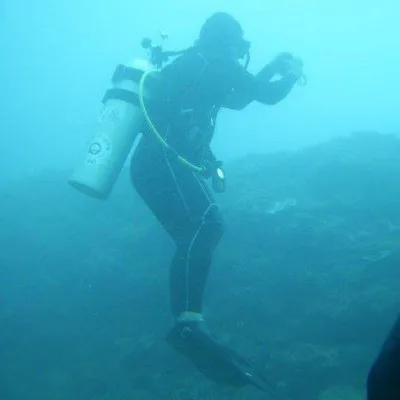
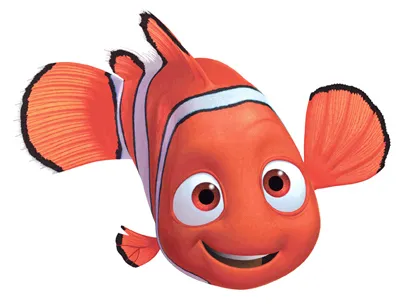
Before we proceed with the details of this species, may we share to you the information that Nemo (a movie character depicting the life of a clownfish) is still missing in Cocos Island. If you try to search the web, you can find little or no information about this highly colorful reef inhabitant on its existence in Cocos Island.
What we mean is that its presence is not yet documented. But we are quite sure that this species thrive in Cocos Island for reasons that the underwater environment of Cocos Island perfectly fits its habitat and that its host sea anemone, such as the Magnificent Sea Anemone (Heteractis magnifica), Gigantic Sea Anemone (Stichodactyla gigantea) and Merten’s Sea Anemone (Stichodactyla mertensii), are thriving in this offshore Costa Rican Island.
So the race begins on who could find Nemo first. Let’s just hope we will not be beaten by sharks and other large predators of Cocos Island in this competition.
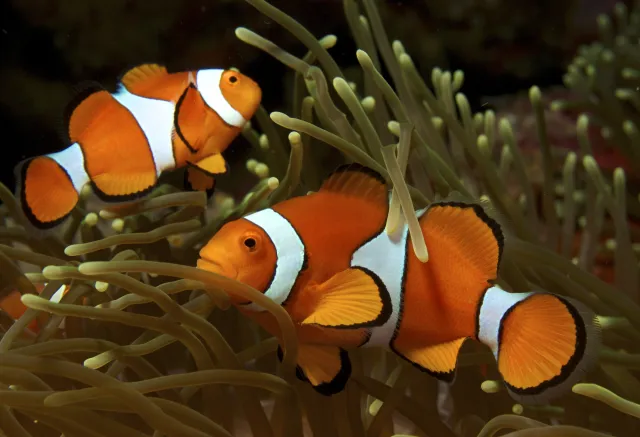
Clownfish (Amphiprion ocellaris)
- Other Names
- Clown Anemonefish, Ocellaris Anemonefish
- Max. Length
- 11 centimeters
- Length at 1st Maturity
- 7.6 centimeters
- Depth Range
- 3 – 15 meters (10 – 50 feet)
- Frequency
- Abundant in Indo-Pacific Ocean but threatened due to its demand in the Live Aquarium Fish Trading
The popularity of a clownfish first began when it was depicted in an animated movie where Nemo, the beloved son of a clownfish, was lost. If this is the case, then Finding Nemo will no longer be just an adventure movie but a real life experience for divers exploring the reefs of Cocos Island in search for this popular reef resident.
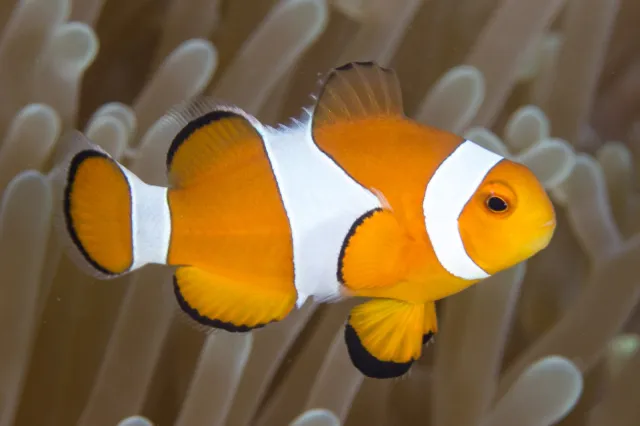
While most of us can easily identify a clownfish, be aware though that there are several species of anemonefish but only one species pertains to nemo. Nonetheless, you can still easily identify a clownfish through its body that has a stocky and oval shape. But what really stands out is the color pattern of their body that is predominantly bright orange in color with 3 vertical white stripes that is being outlined with a fine black line. If you can have a closer look, you will observe that the first vertical stripe passes just behind their eyes while the second line is situated in the central part of the body that widens up to the gills and the third line encompasses the caudal peduncle near the tail.
Clue: Use the Depth Range as a Guide
While most of the depth profile of Cocos island plunges down to deep water drop-offs, finding nemo will basically become difficult as you will often lead your exploration to a deep dive.
With this, be guided that a clownfish does not thrive in a deep water environment and you can take into consideration the data presented in the depth range where nemo is usually found from 3 to 15 meters. So the logical thing to do is to make a shallow dive and increase your chances of finding one. But you have to properly plan your dive as the shallow water environments of Cocos Island are often phased with strong current and surges. Another thing that you can consider is a biological indicator where a clownfish is highly dependent on a host sea anemone for its survival. So, if the area is flourshing with sea anemones, then your chances of beating the big boys of the deep is increased.
Do Not Touch if Found
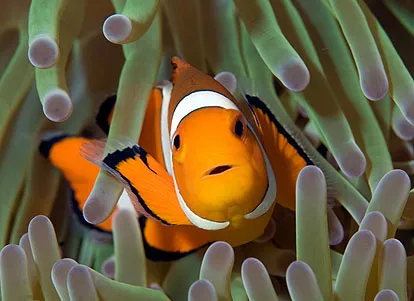
Just in case you found Nemo, please don’t get too excited that you might want to catch or touch it. Be reminded, that while a clownfish poses no threat to humans, the tentacles of its host sea anemone are highly venomous where it can potentially burn or sting your skin. Further, please do not disturb it or take it away from its host or out of the water. We know that you are only doing this for souvenir purposes. Instead, what we highly advise is just to take a nice photograph of this lost and found reef dweller.
Nemo in the Aquarium: Have Mercy on Them
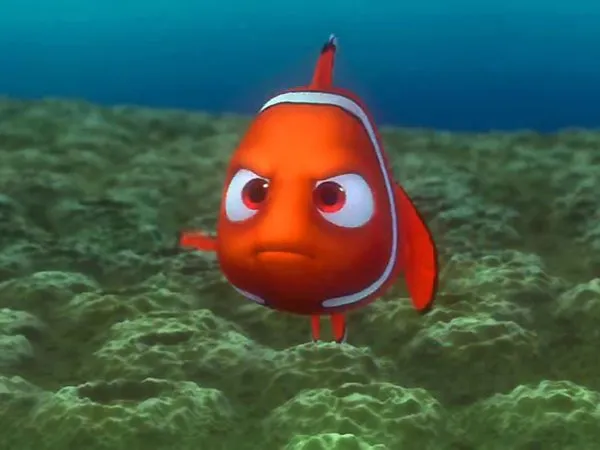
While many already have their saltwater aquariums set with a pair of sea anemone and a clownfish, please do not follow them as this is considered a bad practice. It would be better if you can convince the aquarium owner to release nemo back to the ocean where it truly belongs. But it would be best if you can convince them to go diving and interact with nemo in its natural habitat. Or perhaps, convince them to join the race to find nemo in Cocos Island.
Reference
Fishbase: www.fishbase.org
Marine Bio: www.marinebio.org
Wikipedia: en.wikipedia.org
Video courtesy from BlueWorldTV