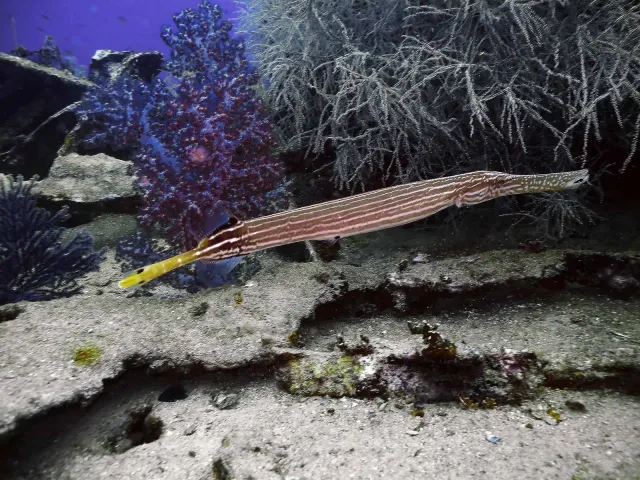
Chinese Trumpetfish (Aulostomus chinensis)
- Max. Length
- 80 centimeters
- Length at 1st Maturity
- 44 centimeters
- Depth Range
- 3 – 122 meters (10 – 400 feet)
- Frequency
- Abundant in Indo-Pacific Ocean
You can easily identify a trumpetfish through its tubular body where its first dorsal fin, that has an erected spine, looks like the 3-finger buttons of a real trumpet while its caudal tail represents the mouthpiece of this musical instrument.
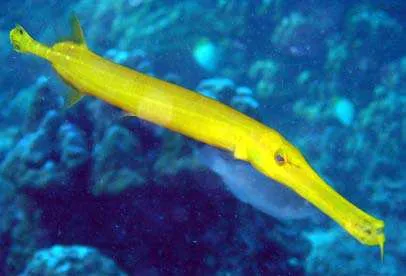
But wait a minute, identifying a trumpetfish may sometimes be confusing especially if you are basing it on body color. You should remember that this particular species of trumpetfish may come in 3 distinct color patterns. Some may come in brown to green, others from mottled brown to green while some may have a solid yellow color. But regardless of what color pattern an individual trumpetfish may have, one thing in common is that they have a black maxillary stripe starting from the dorsal fin running to the anal fin. Presence of dark spots can also be found particularly in the caudal fin where you can find 2 black spots and one in each of the pelvic fin.
A Clever Reef Hunter
If you are able to see a Chinese trumpetfish during your underwater adventures in Cocos Island, try to closely observe if it is on a feeding mode. Observing such an event will truly amaze you on how it captures its meal despite swimming in a horizontal position.
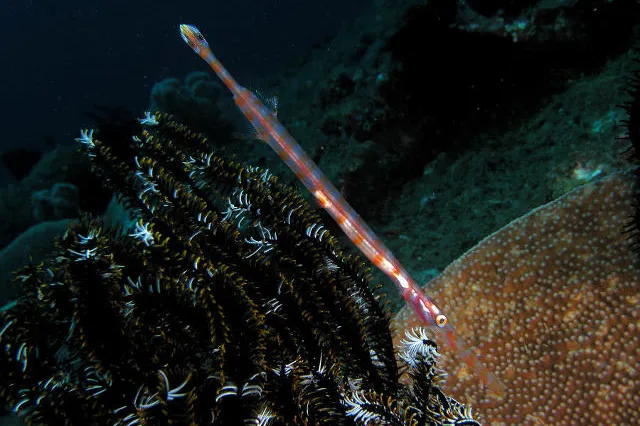
You can see that there are 3 types of feeding techniques a Chinese trumpetfish employs. First, since it is a slow-moving species, it relies on a combination of stealth and camouflage. This allows them to do the “ambush technique” where they can get their prey by surprise while hiding from corals or gorgonians. The second technique is called the “discrete tracking” where you can see a trumpetfish staying close to a large fish or sea turtles where they can easily catch any approaching small fish. The last technique uses its body asset. While trumpetfish is known to slowly swim above the reef, it uses its body length to catch a prey from below by bending and darting down vertically where a prey has no chances of getting out as the predation could happen in just a split second.
Reference
Fishbase: www.fishbase.org
IUCN Redlist of Threatened Species: www.iucnredlist.org
Wikipedia: en.wikipedia.org
Video courtesy from Australian Museum