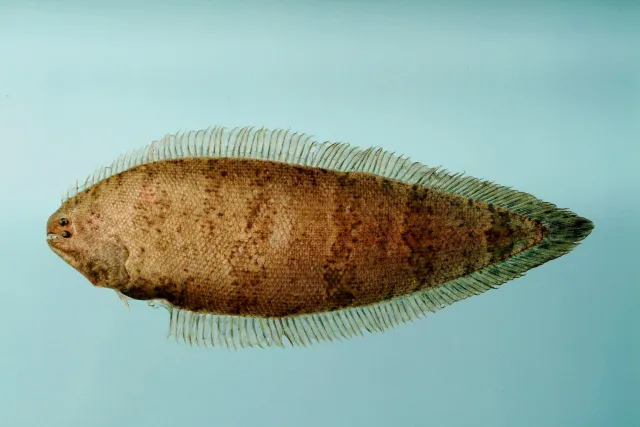
Unicorn Leatherjacket Filefish (Aluterus monoceros)
- Max. Length
- 76.2 centimeters
- Length at 1st Maturity
- 34.7 centimeters
- a value: 0.03760
- b value: 2.760
- Depth Range
- 1 – 80 meters (3 – 260 feet)
- Frequency
- Abundant in the World’s tropical reefs
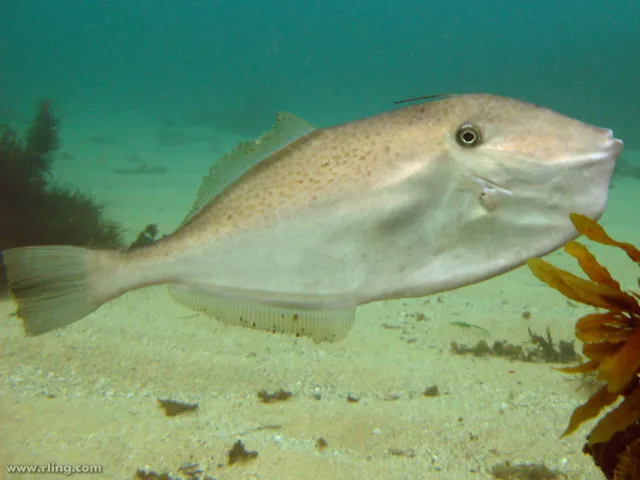
The Unicorn Leatherjacket Filefish is one of the few fish species in Cocos island that you can easily identify. It has no complex body coloration where it is mostly colored flat grey with small brown spots on the upper body. In case you are doing underwater photography with external strobes, you will notice that there will be a greenish undertone that will come out once the light hits the skin.
Unlike its cousin, the pufferfish, the Unicorn Leatherjacket Filefish has only one retractable spine. In fact, it has very few body spines that are semi-retractable and are mostly located on the dorsal portion. The only body part that has a close resemblance to a pufferfish is their snout which both of them has a convex mouth that are designed to crush hard bottom organisms like crabs and shells.
Raises its Unicorn-like Horns when Threatened
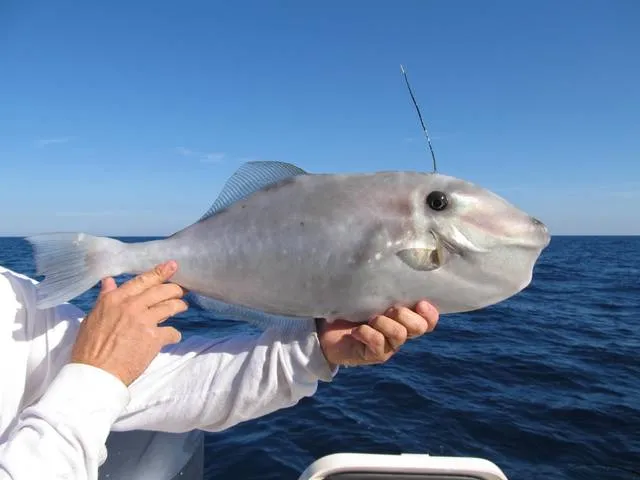
As earlier said that there are few spines that can be found in a Unicorn Leatherjacket Filefish, there is one spine that becomes highly erected when threatened. We are pertaining to the single and elongated dorsal spine that can be found near the head. When relaxed, this particular spine is not visible and mostly embedded within the body. But when it is threatened, like the arrival of predators, this spine is projected upward and represents like the horns of a unicorn. This is the reason why the word “Unicorn” is accompanied in its name. But we warn you, you will not usually see this unicorn-like horn during your underwater adventures in Cocos island and please do not threatened the animal just for the sake of witnessing the protrusion of this spiny body projection.
Camouflage and Lives on Floating Debris

While on the reef floor in one of the dive sites in Cocos island, you may see a Unicorn Leatherjacket Filefish lying close to a solid object. But you have to train your eyes as this particular fish species may blend in with the dull colors of rocks and sand. But your chances of seeing a Unicorn Leatherjacket Filefish on the reef is slightly lower as compared to their favorite hang-out.
Towards the end of your dive, particularly during the start of your ascent or making a safety stop at 3 meters (15 feet), you may see a lump of debris where a Unicorn Leatherjacket Filefish is often spotted beneath it. These debris maybe made from organic accumulation of seagrass and algae or it maybe a group of garbage clumped together by waves and tides.
Rough as a File
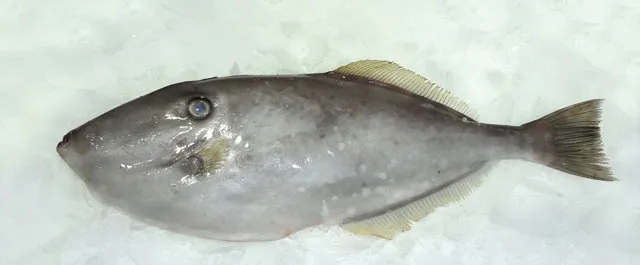
If you were able to overcome the camouflage properties of a Unicorn Leatherjacket Filefish, then you can now have a clear view of this elusive species. The first thing that you will notice is their skin. At first, their skin looks like a shiny shade of glass. But as you examine it closely or (only if you have the opportunity) if you have the chance to touch the skin of a Unicorn Leatherjacket Filefish, you will realize that it is rough as a file or sandpaper. Aside from roughness, their skin is anatomically thick as compared to other reef-associated species. Their skin properties has enhanced their defense mechanism against predators giving them an added body armor.
Reference
Fishbase: www.fishbase.org
IUCN Redlist of Threatened Species: www.iucnredlist.org
Encyclopedia of Life: www.eol.org
Video courtesy from umiponpon