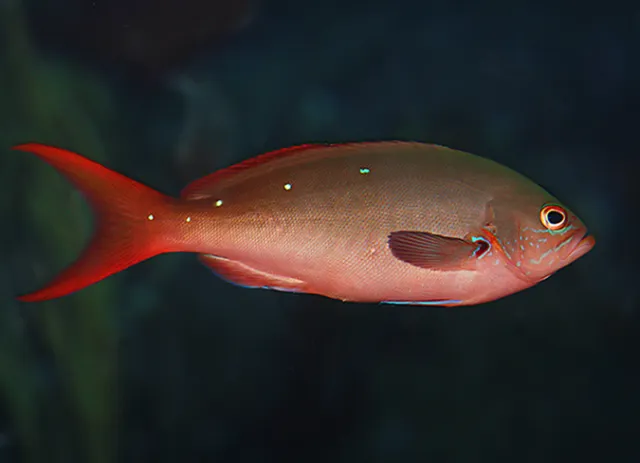
Pacific Creolefish (Paranthias colonus)
- Max. Length
- 35.6 centimeters
- Length at 1st Maturity
- 21.5 centimeters
- Depth Range
- 10 -70 meters (30 – 230 feet)
- Frequency
- Abundant in reefs of the Eastern Pacific Ocean
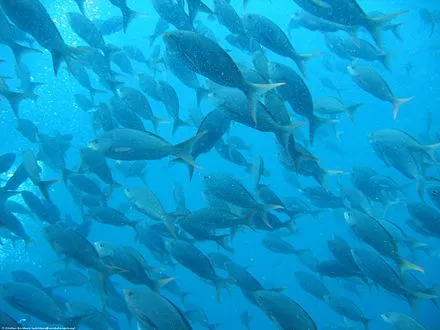
Although it is closely related to groupers which are known to be solitary and highly territorial, the Pacific Creolefish is one of the schooling reef-associated fish that often swims around in groups. During your underwater adventures in Cocos island, you can see Pacific Creolefish in small aggregations of 50 to 100 individuals.
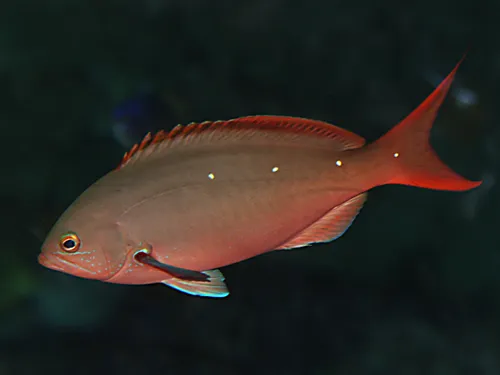
While there are many species of schooling fish in Cocos island, you can still easily identify a Pacific Creolefish through its red to reddish-grey body color. If you can have a closer look at them, you will observe that there are 5 prominent dots that are colored white with a blue-violet undertone. These dots are placed horizontally along the body where you can find 3 of them at the central portion while 2 can be found near the tail.
Microscopic Vision
Given the knowledge that members of the Grouper Family (Serranidae) are carnivorous, this also applies to a Pacific Creolefish, but in a unique way. Yes, they are still carnivores but selectively eats small microscopic animals where no naked human eyes can see. This is made possible through their shortened snout which facilitates microscopic vision that functions like a close-range binoculars.
This is the the reason why members of a schooling Pacific Creolefish has a tendency to divert its swimming pattern away from the main group in pursuit of their favorite microscopic meal. You can see them swimming away momentarily from the group but will rejoin once its gastronomic appetite has been satisfied.
An Excellent Baitfish
In the field of sports fishing, the Pacific Creolefish is an excellent baitfish where big pelagics, that are in pursuit of the fishing line, is often triggered with excitement as the swaying movement of a baited fish resembles like a fish in distress, thinking that it is an easy meal.
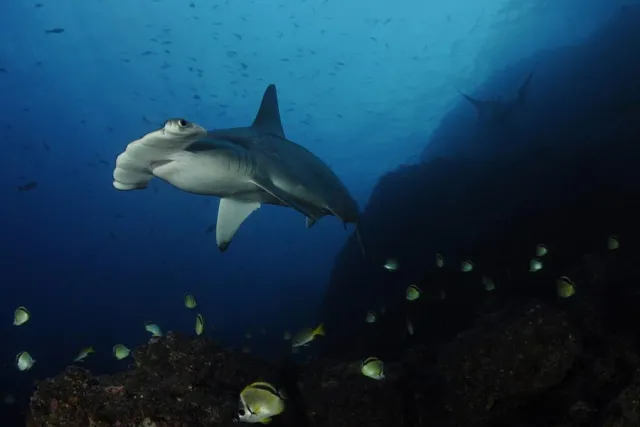
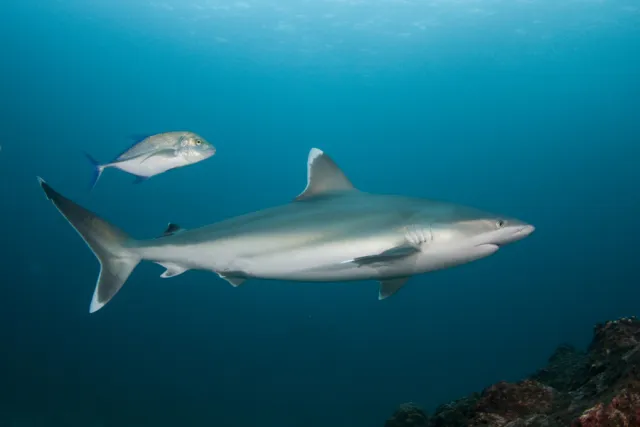
But we are not fishermen. We are divers. We want to see live fish in their natural habitat rather than making them as a bait to catch larger fish. On a lighter side, we still can use the concept of “baitfish” in your underwater explorations in Cocos island without hurting a single fish in the process. You should take note that a school of Pacific Creolefish is often followed by bigger fish, like sharks, jacks and tunas, hoping to munch in for a delicious seafood meal.
Reference
Fishbase: www.fishbase.org
IUCN Redlist of Threatened Species: www.iucnredlist.org
Encyclopedia of Life: www.eol.org