Mexican Goatfish (Mulloidichthys dentatus)
- Max. Length
- 31 centimeters
- Length at 1st Maturity
- 19 centimeters
- Depth Range
- 3 – 46 meters (10 – 150 feet)
- Frequency
- Abundant in the reefs of the Eastern Pacific Ocean
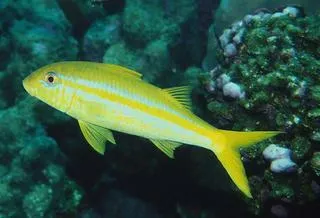
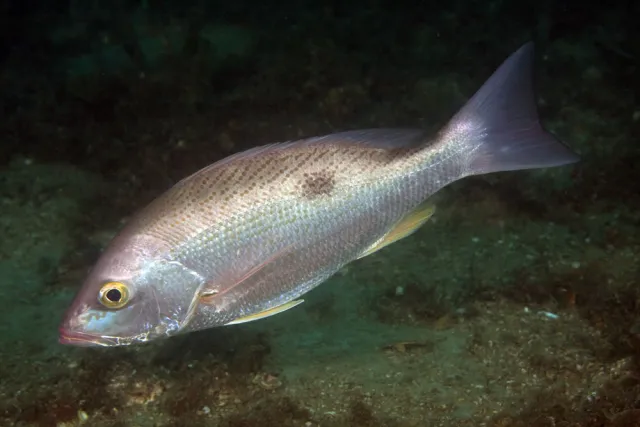
The mexican goatfish is one of the few species in Cocos island where it is endemic only to the eastern portion of the Pacific Ocean. You can easily identify this highly carnivore species through its light blue-pink colored body with a broad bright vertical yellow stripe bounded by a thinner bright blue stripe. Their tail fins are brightly colored yellow while the head is colored yellow green.
During your underwater adventures in Cocos Island, you usually see a mexican goatfish in school of 50 to 100 individuals where they mostly thrive in the rocky crevices and sandy bottom.
Why are they called Goatfish?
The main reason why they bear the name is a pair of protrusions in front of their mouth called barbels. It is comparable to a goat’s beard and has something to do with how it feeds.
Goats and goatfish feeds similarly where they graze the ground for food. The only difference between their feeding habit is that goats don’t need to find their food where grass is perpetually sprouting on the ground while goatfish needs to search for their meal as this is often hidden under the sand. This is where the purpose of their barbels comes in. Their barbels are actually an extension of their mouth where it is highly sensitive to touch and taste. Kidding aside, I just can’t imagine this with humans.
If you were able to see a school of Mexican goatfish in Cocos island, you will notice that their barbels are tacked in when they are swimming and only protrudes when they arrive at a site where food on the ground is abundant.
Reference
Fishbase: www.fishbase.org
IUCN Redlist of Threatened Species: www.iucnredlist.org
World Register of Marine Species: www.marinespecies.org
Video courtesy from scubabacus