Cocos Grouper (Serranus tico)
- Other name
- Cocos Serrano
- Max. Length
- 8.5 centimeters
- Length at 1st Maturity
- 6.1 centimeters
- Depth Range
- 10 – 43 meters (33 – 140 feet)
- Frequency
- Abundant only in Cocos island and Malpelo Island of Colombia
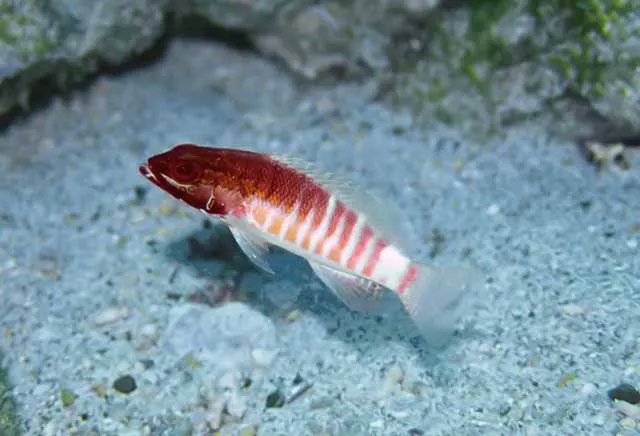
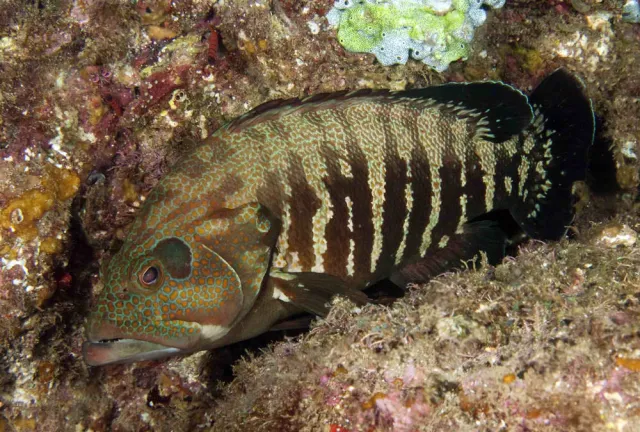
The Cocos Grouper is one of the reef-associated fish in Cocos island that has a variety of body color and pattern. If you try to focus on their head, you will see that they have a bluish-brown coloration with a pair of red-orange stripes on the snout. With regards to their body, you will find 8 vertical stripes wherein these stripes are colored red on the upper portion and fades away to bright yellow as the line goes down. Moving further back to its tail, you will see that there is a solid white bar before a red vertical line appears as it reaches the base of its caudal fin. There are no enlarged spines that protrudes through its elongated and moderately compressed body.
While the body color and pattern of a Cocos Grouper may interest you and want to find them in other dive sites, you should take note that they are endemic only to Cocos Island of Costa Rica and Malpelo island of Colombia.
Not your Regular-Sized Grouper
If you think that this particular grouper is large as what its close cousins are, then think again. In general, groupers are medium to large-sized fish. Their bodies are filled with white muscular meat and this is the reason why they are the preferred seafood especially in Chinese restaurants. However, all the species under the genus Serranus are relatively small in size and has been given the general term: Dwarf Grouper. For the Cocos grouper, they only have a maximum size of 8.5 centimeters.
Despite their miniature size, this does not mean that there features of being a grouper are also downsized. Similar to its larger cousins, a Cocos grouper is highly carnivorous. They eat anything that moves, as long as the food can fit its mouth.
A Hermaphroditic Fish
We all know that humans are either born man or woman, although cultural evolution has allowed the concept of sexual preference and modern science has made way to the modification of both sexes. But as far as Cocos grouper is concerned, they are a hermaphroditic fish. Meaning, each individual fish are both male and female. They both have functional male and female reproductive tissues and organs. But how do they reproduce?
It all starts with courtship. The fish that has the dominant characteristics like aggressive behavior, brightness in body color, bigger in size and higher in reproductive tissue, automatically becomes the male. The rest of the underdogs becomes the female.
Reference
Fishbase: www.fishbase.org
Smithsonian Tropical Research Institute: www.biogeodb.stri.si.edu
ArcGIS: www.arcgis.com