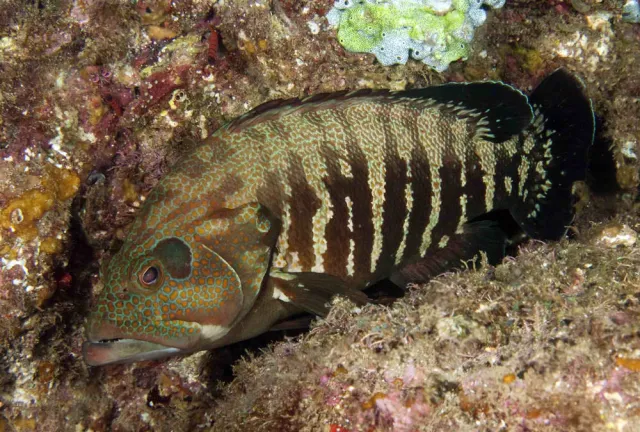
Mottled Soapfish (Rypticus bicolor)
- Max. Length
- 28 centimeters
- Length at 1st Maturity
- 17.4 centimeters
- Depth Range
- 3 – 68 meters (10 – 225 feet)
- Frequency
- Abundant in the rocky reefs of the Eastern Pacific Ocean
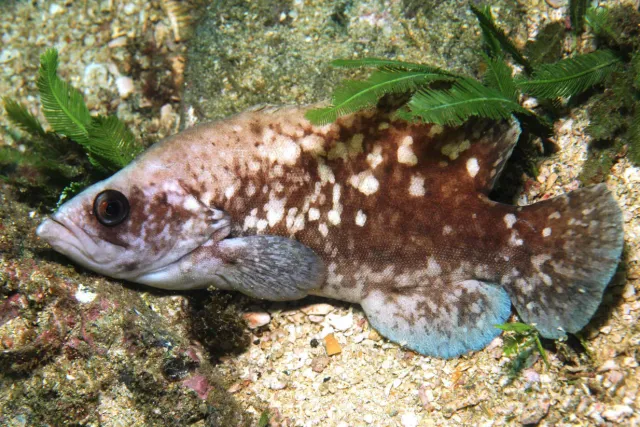
If you happen to see a mottled soapfish during your underwater adventures in Cocos island, you will have an impression that you had just interacted with a primitive fish. This is due to the fact that their body is colored dull brown with cream to pale-brown spots that are mottled on the side of its body. This body coloration is one of the features of a primitive fish where their over-all body color is dull or not attractive to predators as compared to the modern fish that are brightly colored. Contributing further on their unique body characteristics, you will notice that all their fins are thick and fleshy. On top of this, their scales are embedded deep within their skin acting as a solid armor rather than the superficial scales of a modern fish that can be compared to an unstable shield.
A Night Stalker
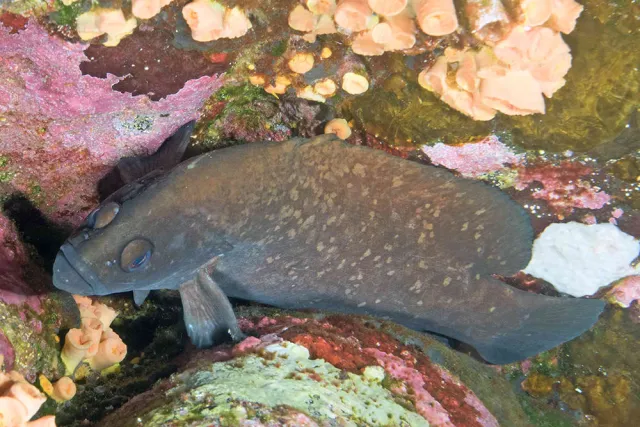
Mottled soapfish thrives in cracks, crevices or any rocky areas of the reef. During daytime, you will see them lying motionless on its side giving you the impression that they are sleeping. They may occasionally wander out to nearby areas of the reef. But when the sun sets in and darkness fills the reef, a mottled soapfish will come out of its den and roam around in search for food where they prefer to eat small fish. This particular characteristic has made them to be classified as a nocturnal hunter.
You may wonder why they occasionally wander around the reef during daytime and not hunting. While there is no concrete reason to explain this behavior, you may consider it as a surveillance act for them to easily locate their food when night time comes.
Why are they called Soapfish?
First and foremost, soapfish in general are not the main ingredient in making soap that we use in cleansing our body when we take a bath. The main reason why they are called soapfish has something to do with their natural skin oil.
As a bodily response to stress and when soapfish are threatened, they secrete a large amount of mucus where it is often excreted out of the pores of its skin. This body mucus contains toxins called grammistin which is very effective in repelling potential predators. If you happen to touch a mottled soapfish underwater, if not in the market, you will observe that this body mucus will form a soapy solution that is very stinky. This just proves that their toxin is highly efficient as a predator repellent even if the animal is already dead.
Are Mottled Soapfish really a primitive fish?
While most of their body features points them to be a primitive fish, but in reality they are not. As far as bony fish is concerned, the real indicator of a primitive fish is the positioning of their fins rather than type or composition as this can be manifested through evolutionary adaptation.
If you try look at the dorsal and pelvic fins of a primitive fish, you will notice that it is located more to the rear rather than near to its head. This feature is perfectly manifested by the Coelacanth (Latimeria sp.). However, you cannot find any coelacanth species in Cocos island as there are no reports of their presence in this offshore Costa Rican island. But who knows, the possibility of finding them is not yet closed as coelacanth were thought to be extinct and was just recently discovered again to be living in the deep trenches of our ocean. This means that the possibility of finding one will be higher if you go in to a deep-sea submersible. However, we are not suggesting that you go deep-sea diving just to search for Coelacanth and other primitive fish. But what we would like to emphasize is that the abyssal depths of Cocos island is still a mysterious place and we only know little knowledge about the depths of our oceans. But again, who knows, a Coelacanth might appear right in front of the dome of your deep-sea submersible. So, always be ready with your camera.
Reference
Fishbase: www.fishbase.org
IUCN Redlist of Threatened Species: www.iucnredlist.org
World Register of Marine Species: www.marinespecies.org