Blacktip Cardinalfish (Apogon atradorsatus)
- Max. Length
- 8.9 centimeters
- Length at 1st Maturity
- 6.3 centimeters
- Depth Range
- 3 – 46 meters (10 – 152 feet)
- Frequency
- Abundant only in the offshore reefs of Malpelo, Galapagos and Cocos Island
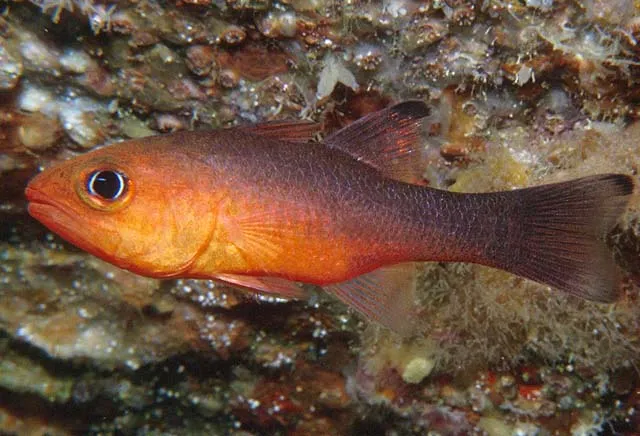
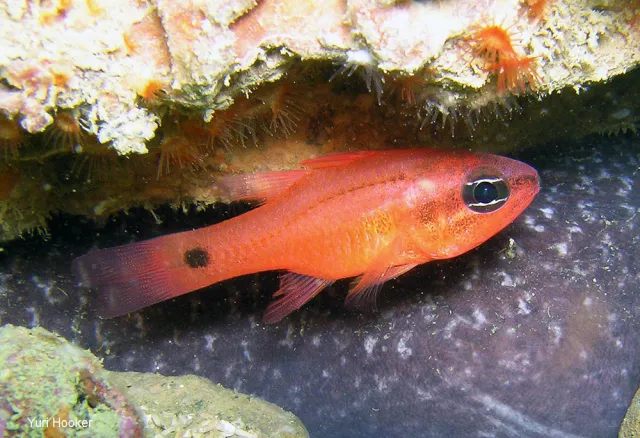
A blacktip cardinalfish is another reef-associated fish that you can see in Cocos island that thrives on the sides of rocks, cracks and crevices. You can easily identify them through its brown-red colored body that is compressed and oblong in shape. On top of their general body color, a dash of yellow orange is prominent on the lower half of its head that goes further down to its belly.
While their head and eyes are large, their snout is relatively small and a dental system that is mostly concentrated on the side of their jaws. The caudal fin is slightly concave in shape and their body scales are rough and deeply embedded.
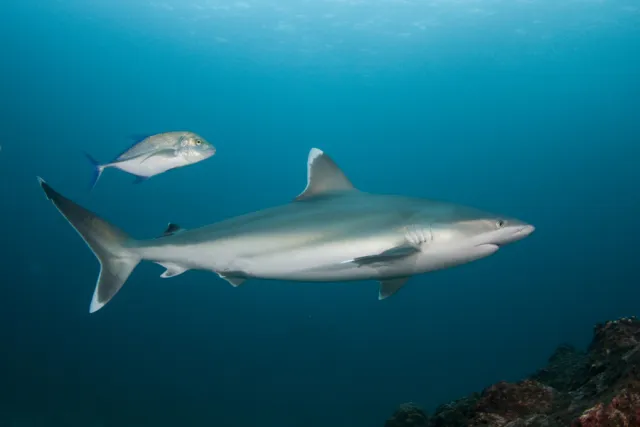
But what really stands out for an easy identification of this fish is the black coloration that can be found on the tip of their fins. Taking a closer look, you will see that there is a black shade that contrast its brown-colored fins especially on the dorsal and caudal portion. This bodily feature is similar to the characteristics exhibited by a blacktip shark.
Hangs-out at Night
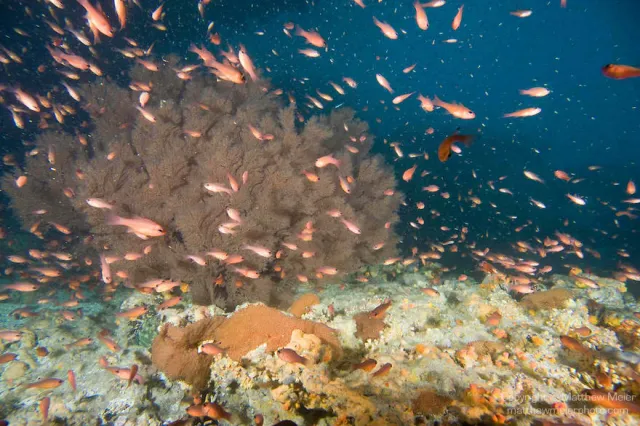
Blacktip cardinalfish, as well as other species of cardinalfish in general, stays on the dark recesses of the reef during the day. This is the reason why you often see them on the side of rocks, cracks, crevices or any structure that offers an overhang shade.
But when night time comes or when light is significantly reduced especially during long periods of cloud cover, they go out, leave the confines of their hiding place and feed in the open.
Although they prey on tiny shrimp and fish, their primary nourishment comes from microscopic organisms called plankton. If you happen to go night diving or diving in a gloomy condition, you will observe that blacktip cardinalfish will hover in mid-water while facing against the current. This method of feeding allows maximum entry of plankton-rich water in their mouth. This can be comparable on how manta rays feed in the water column. The only difference is that manta rays need to glide and scoop in huge amount of water in their mouth using their cephalic horns while cardinalfish will just hover motionless where they only need a few amount as their body is relatively small.
Kidding aside, can you imagine if this feeding method is being used by human beings? If so, then we don’t need to go to work and earn money to buy food. Just open your mouth.
Reference
Fishbase: www.fishbase.org
IUCN Redlist of Threatened Species: www.iucnredlist.org
World Register of Marine Species: www.marinespecies.org