Rough-Toothed Dolphin (Steno bredanensis)
- Max. Length
- 280 centimeters
- Max. Weight
- 150 kilograms
- Frequency
- Found in Indo-Pacific Ocean
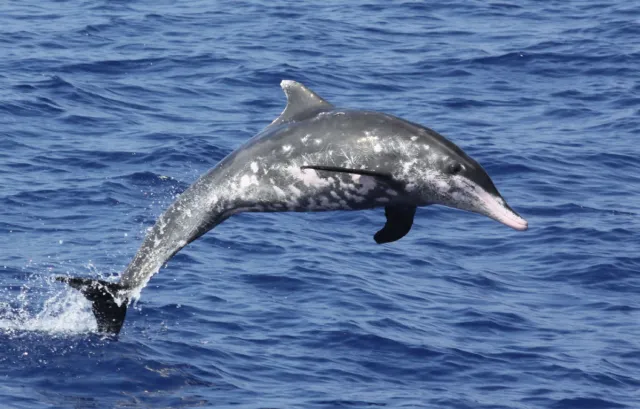
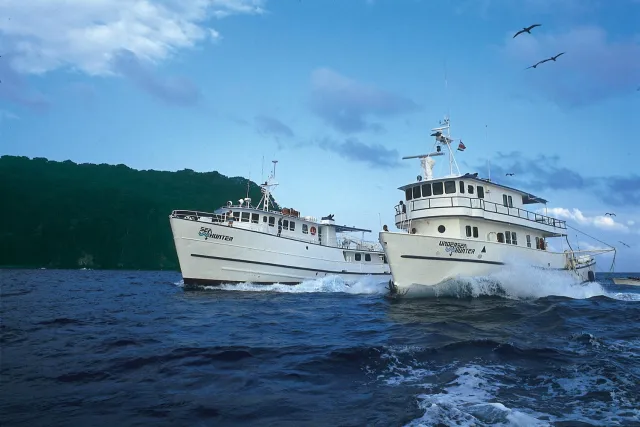
Midway during your 36-hour journey from Costa Rica going to Cocos island, the chances of spotting a rough-toothed dolphin is high. While they can usually be found near the surface, rough-toothed dolphins prefer to thrive in waters away from any landmass that has a depth of at least one kilometer.
In order to guide you in identifying a rough-toothed dolphin, since there are other species of dolphin thriving in the open sea, we suggest you follow this simple steps. First, look at the body size. Rough-toothed dolphins are bigger than any other dolphin species. If in case you have difficulty differentiating the size of every dolphin species as they are fast moving, then body features would definitely guide you to the targeted species.
Among its prominent body feature is their conical head that has a slender nose. This combination of head feature gives you the impression that they have concave space in their head that slides down along the upper jaw. While they are known to follow your vessel, particularly on the bow section, this gives you an opportunity to observe the basis of their nomenclature. As their name implies, their teeth has a distinct rough surface with numerous irregular ridges.
Adults have distinct Lip Color
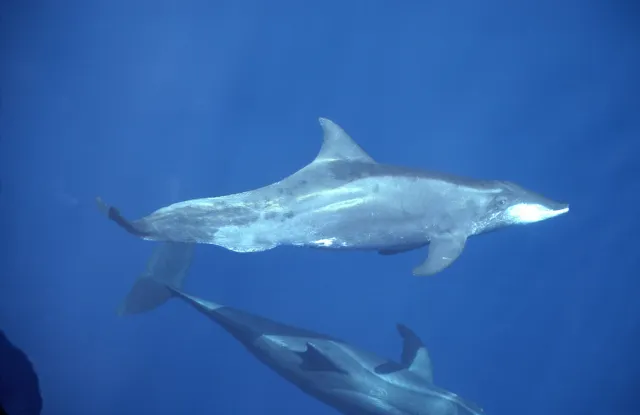
If we try to look at the indicators of other adult species of dolphins, you can say that the obvious basis is the size and robustness of their body. Group behavior can also be an indication where most adults are found on the front side of the group which acts as a leader.
However, while these indicators can also be applied to a rough-toothed dolphin, one of their anatomical structure will give you a good indication. Focus your sight on their lips. You will notice that adults has a distinct coloration at the tip of their jaw. This coloration could vary depending on the area or locality where the ones you see in Cocos island are colored white or yellow.
Swims in a School called Pod
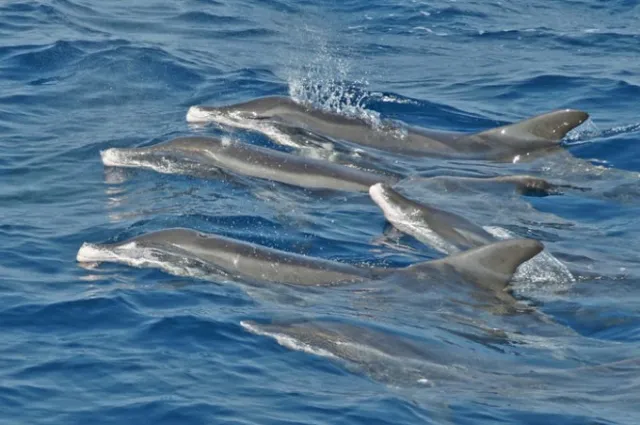
As a common factor to all its close cousins, rough-toothed dolphins swims in groups. But unlike a school of fish, their group is called a Pod. In short, the correct term for their grouping is called a pod of dolphins and not a school of dolphins.
A pod of rough-toothed dolphins is relatively small compared to other species of dolphins. It usually consist of ten to twenty individuals. But once in a while, several groups converge in to a single big pod, especially if they are in chase of their favorite meal which comes in big volume. They can also converge during mating.
What is remarkable when they converge is they simultaneously skim off the water as shown on the picture in this section. They do this by lifting their head and chin just above the water, sort of like their own way of playing. While most dolphins produce sounds, rough-toothed dolphins has its own signature voice. They either produce a brief sound that is comparable to a click of a mouse or a long and extended clatter that can be compared to the sound of a whistle.
Let’s take a Quick ID Test
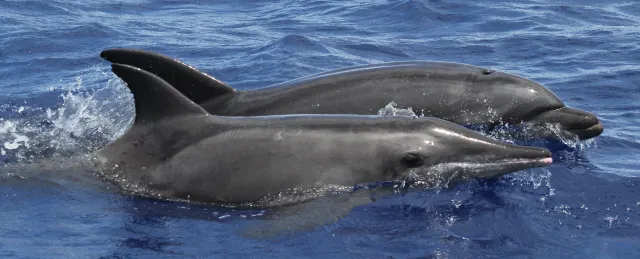
While dolphins generally swims in groups, most pods are comprised of one or more species. For you to be prepared in a multi-species dolphin interaction, you might as well practice your identification skills. Please take a look at the picture below and tell us which animal is a bottlenose dolphin and which is a rough-toothed dolphin.
Book or inquireReference
Sealife Base: www.sealifebase.org
Wikipedia: www.wikipedia.org
Costa Cetacea Blue Eco Blog: www.costacetacea.com
Video courtesy from Richard Parkinson