Prickly Shark (Echinorhinus cookei)
- Max. Length
- 400 centimeters
- Length at 1st Maturity
- 182.3 centimeters
- Depth Range
- 10 – 1,100 meters (30 – 3,630 feet)
- Frequency
- Usually found in deep-sea environments
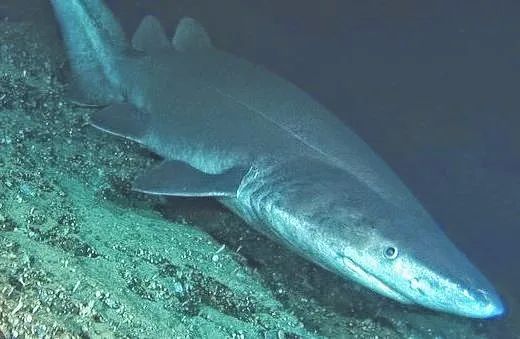
You can easily identify this large but sluggish shark through its grey colored stout body that has a black distal fin margin with a white undertone around the mouth going to the ventral portion of its short snout.
It has no anal fin, but instead, it has a subterminal notch on its caudal fin. It has 20 to 23 teeth in each jaw layered in 5 rows of dental system where it has been effective in getting its food where some of its favorite meal are large fish, octopus, squids and other sharks.
A Deep-Sea Experience
While there a few reports of a Prickly shark surfacing up in shallow waters, they are best known to thrive in deep-sea environments like a continental shelf where darkness is absolute.
Not unless if you are super lucky to see a prickly shark during your scuba adventures in Cocos Island, the only way to get a glimpse of this deep-sea species is through a submersible.
Once you reach the abyssal zone of the ocean with depths reaching over 1,000 feet, you’re chances of seeing a prickly shark will start to increase. Most of the interaction of a prickly shark occurs in deep seamounts where you can see a prickly shark patrolling near a rocky or sandy substrate. It is not often seen hovering over deep waters and trenches. Since you are using artificial light courtesy from your submersible, a prickly shark may shift into hunting mode where they can easily see their food . . . not you, but fish, squids and octopus.
Prickly it is
Have you ever wondered why its called a prickly shark? If only you could touch the skin of this particular shark, then you would probably know the answer.
A prickly shark has thorn-like denticles which are skin protrusions scattered all around its body. Each denticle can reach up to 4mm in length that is equally spaced in between creating a biological armor for the shark. Kidding aside, it’s just like a shark wearing a chain mail.
Reference
Fishbase: www.fishbase.org
IUCN Redlist of Threatened Species: www.iucnredlist.org
Wikipedia: en.wikipedia.org
Video courtesy from Shark Academy