Cocos Blue-Banded Goby (Lythrypnus cobalus)
- Other Names
- Knave Goby
- Max. Length
- 10 centimeters
- Length at 1st Maturity
- 6 centimeters
- Depth Range
- 5 – 30 meters (16 – 100 feet)
- Frequency
- Abundant and Endemic to Cocos Island
If one of the sought-after subject for macro-photography in Galapagos island is the Galapagos Blue-banded Goby (Lythrypnus gilberti), then the Cocos Blue Banded Goby is its counterpart here in Cocos Island.
You can easily identify a Cocos Blue-Banded Goby through its orange colored body that has 5 vertical blue streak lining that starts at the head and runs up to tail portion. This Cocos Island Endemic Species are classified as bottom dwellers where you can see them lying on a reef surface and never leaves the confines of their refuge.
Small in Size but Big in Appetite
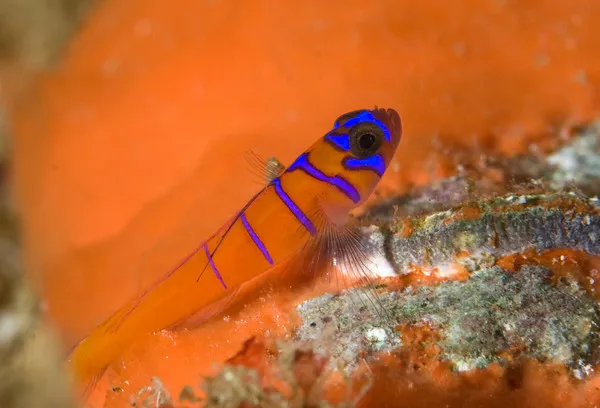
The Cocos Blue-banded Gobies are one of the smallest reef inhabitants of Cocos Island. But despite their relative small size, the ration of their appetite goes way over their size. Well, for a fact, they only consume what can be taken inside its small mouth. But in terms of quantity, we can say that gluttony is committed daily by this endemic cocos goby. Further, they are called as micro-carnivore where they can consume several small reef inhabitants like small crustaceans and fish. They also employ the ambush type of feeding where they can hide in cracks, crevices and even under the thorns of a sea urchin waiting for a meal to pass by.
Doing a Macro-Photography
For all you underwater photographers out there, while Cocos Island is known for wide angle photography where you can easily choose a subject from the long list of large pelagic species, there are still a number of small critters in Cocos Island that can be the subject of your lens’ attention and one of this is the Cocos Blue-banded goby.
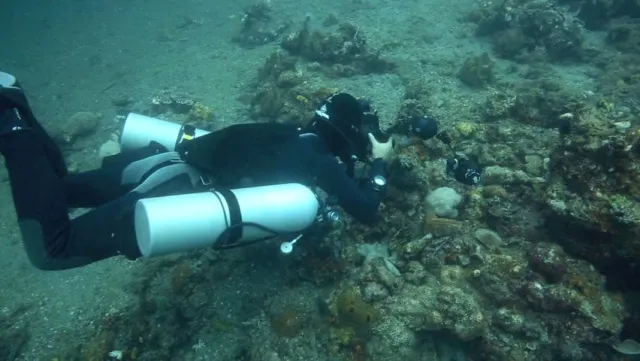
In case you brought your underwater camera system that has a macro mode and you wish to take a photograph of this endemic goby, we highly suggest that you give your attention to the upper parts of a reef where a Cocos Blue-banded goby can easily be seen lying on top of a reef structure. Please take note that they are highly sensitive to our presence and may take refuge in cracks and crevices if we come too close to them. With this, we highly suggest that you position yourself from a distance and slowly come near to your subject where you neutral buoyancy skills will be put in to the test.
Reference
Fishbase: www.fishbase.org
IUCN Redlist of Threatened Species: www.iucnredlist.org
Arkive: www.arkive.org