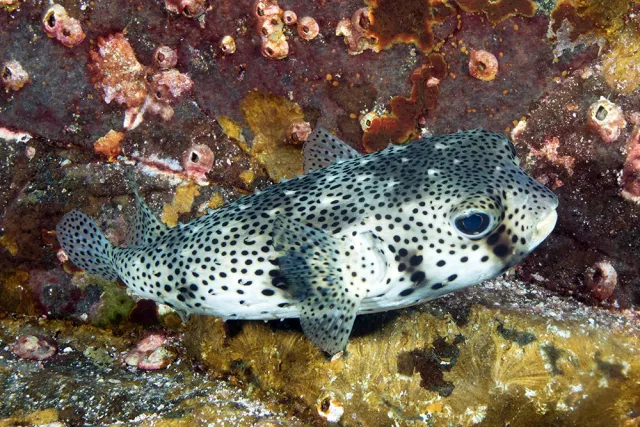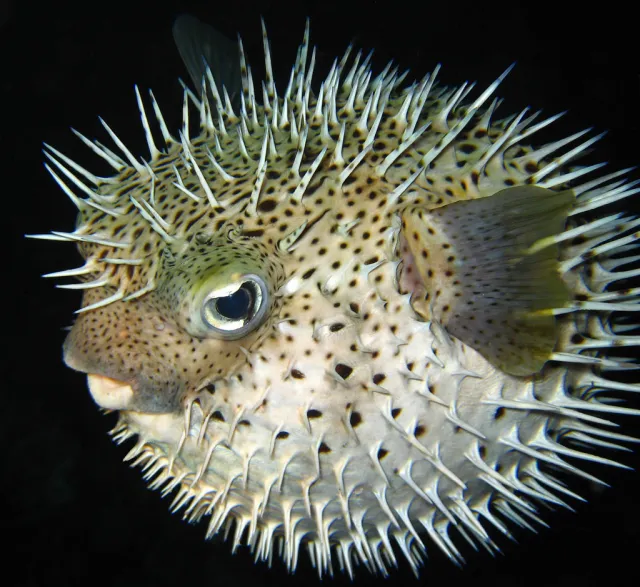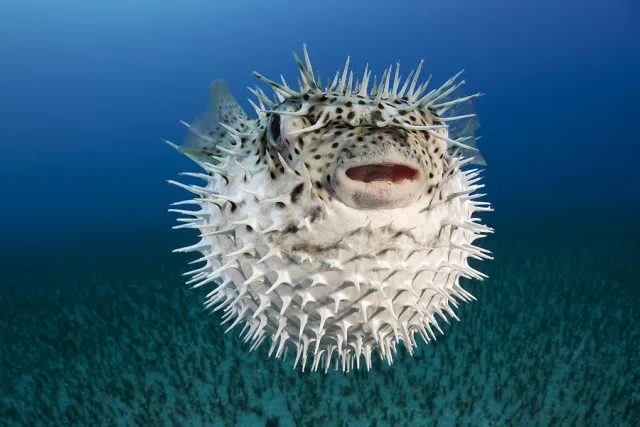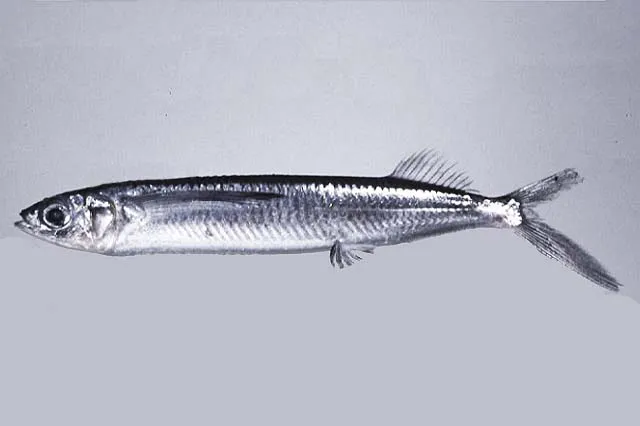
Longspined Porcupinefish (Diodon holocanthus)
- Other Name
- Freckled Porcupinefish
- Max. Length
- 50 centimeters
- Length at 1st Maturity
- 15.4 centimeters
- Depth Range
- 2 – 200 meters (6 – 600 feet)
- Frequency
- Abundant in the world’s tropical coral reefs
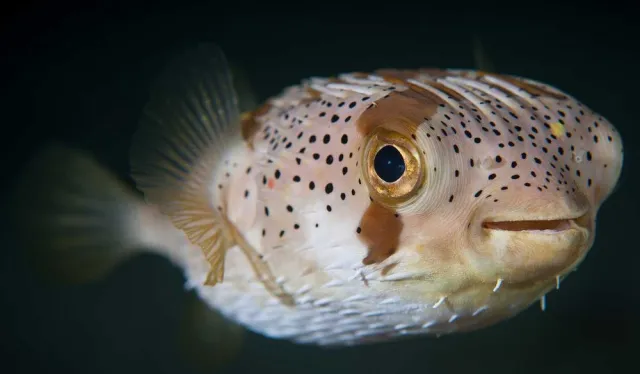
When you go scuba diving in Cocos island and see a smiling fish that has spikes surrounding its body, then you might just interacted with a longspined porcupinefish. Although there are other species of porcupinefish in this offshore Costa Rican Island, you can easily distinguish a longspined porcupinefish from its close relatives through its pale colored body that is filled with dark spots and covered with spines that can be contracted or erected when threatened.
Aside from their spiky skin, what will truly get your attention is not their unique body structure, but their smile. In reality, it is not really a smile like we humans do as a gesture, but rather an impression created by its facial anatomy courtesy from its mouth that are both large and protruding.
Dots of a Longspined Porcupinefish will tell you the Age
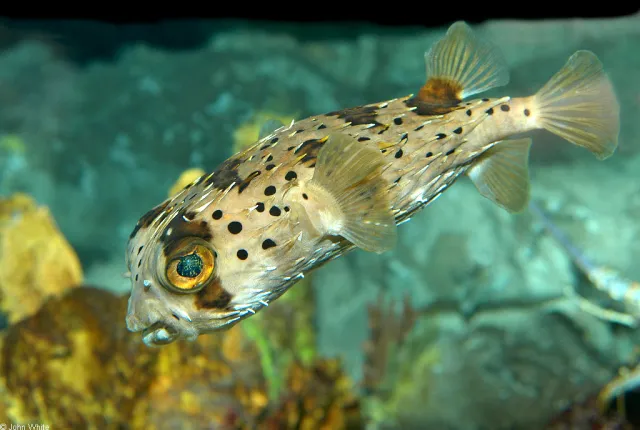
If you think that you need to measure the dark spots of a longspined porcupinefish and compute their age using a formula (just like measuring the internal rings of a tree), then it might take you ages or the computation itself may mislead you. Just remember this: the size of a dark spot in a longspined porcupinefish is inversely proportional to its age. Meaning, when it is still a juvenile, there are many black spots that are usually big in size and subsides, both in size and quantity, as they grow old. Aside from the size of the spots as your indicator in determining the age, their behavior can also be a distinguishing factor where juveniles and sub-adult mostly thrive in the shallow areas of the open water environment. Further, a juvenile longspined porcupinefish tend to hide under floating objects, where most cases in Cocos Island, you can find them under a clump of floating algae.
Do not Touch or Hold an Inflated Longspined Porcupinefish
When a longspined porcupinefish is threatened or provoked, it will take in water causing its stomach to bloat which triggers the protrusion of their body spikes. While the spikes create a body armor, they consume too much energy just to stay upright causing them to swim slowly despite the hard effort.
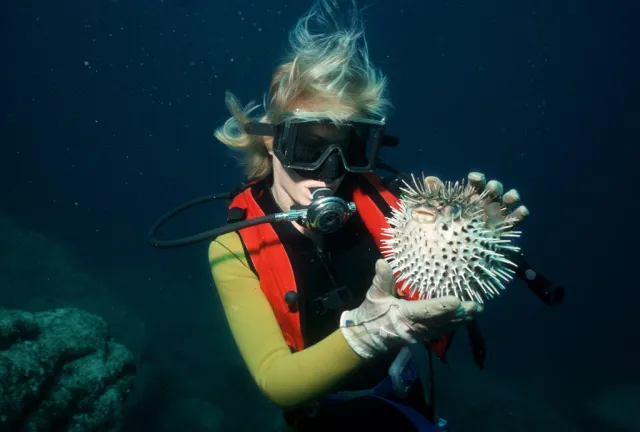
During their inflated state, most divers tend to touch or hold them as you can easily do it since the animal is moving slowly. However, what we do not know that once we hold or touch them, they exert more effort as they are increasingly threatened by our presence. Same with humans and other animals, too much exertion can lead to exhaustion where an exhausted longspined porcupinefish can easily be preyed upon by other predators.
The picture in this section exhibits our typical behavior when we see an inflated longspined porcupinefish. Therefore we highly suggest not to touch or hold, not just a longspined porcupinefish, but other marine species as well.
TTX, Ciguatera and other Poisonous Substance
In case you still have this urge or interest to touch and hold a longspined porcupinefish, then this section may finally discourage you to do so. Aside from the fact that you already know that all porcupinefish contains parasites and neurotoxins like tetrodotoxin (TTX), they also have a foodborn illness called ciguatera. Lucky for you and for us, all of this deadly poison can only be lethal if consumed. With all this information, we suggest that the best way to interact with a longspined porcupinefish is through your sight and not with your hands.
Reference
Fishbase: www.fishbase.org
IUCN Redlist of Threatened Species: www.iucnredlist.org
Encyclopedia of Life: www.eol.org
Video courtesy from Nikolay Onishchenko