Burrito Grunts (Anisotremus interruptus)
- Other Name
- Yellow-tailed Grunt
- Max. Length
- 51 centimeters
- Length at 1st Maturity
- 29.3 centimeters
- Depth Range
- 3– 30 meters ( 10 – 100 feet)
- Frequency
- Abundant in reefs of the Eastern Pacific Ocean
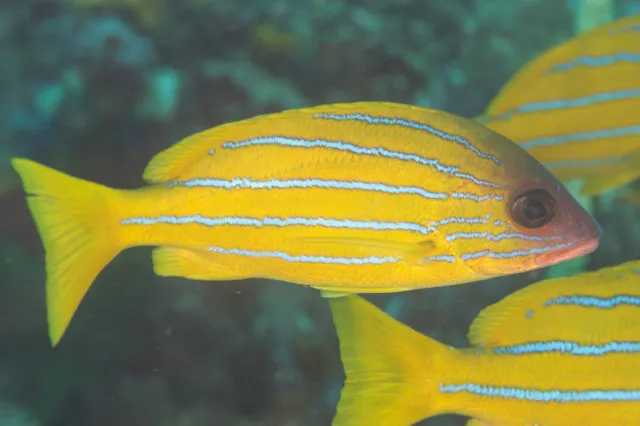
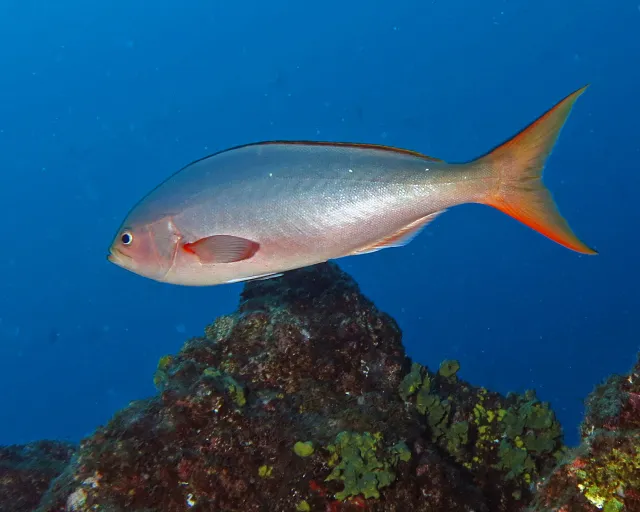
This is one of the fish species in Cocos island that has a highly compressed body with a mouth that is small and terminally located. Further, the lips of its mouth is considered relatively thick and fleshy and is usually pale colored. With this description, you can visualize the face of this reef-associated species with features similar to a bulldog. British or American? Take a closer look at our cover picture and decide which has a close resemblance.
On top of your comparative observation, you may also want to know that burrito grunts may exhibit 2 types of colors for their caudal tail. During you underwater adventures in Cocos Island, you can see some species that has a brown colored tail while others have a yellow-colored tail, thus earning its secondary name.
Extreme Social Behavior
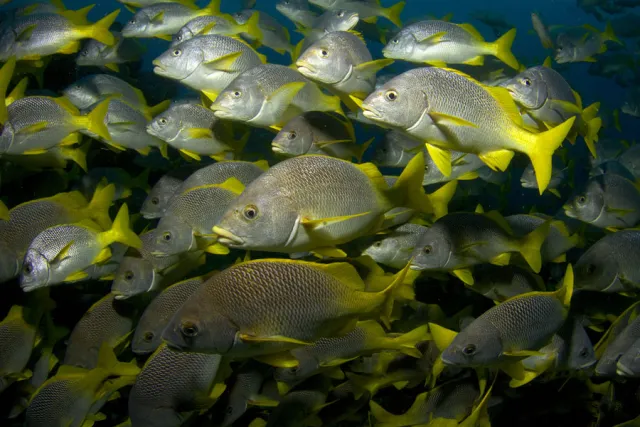
In general, most fish tends to create a pattern where they are considered either to be solitary or in groups called school. As far as the burrito grunts in Cocos island is concerned, they exhibit both patterns. You can either see them in solitary while hiding in cracks and crevices which supports their biological characteristic or see them in a school of over 30 individuals which perfectly describes their social behavior. Well we can say that humans exhibit a close resemblance to this characteristic.
But what really stands out if we try to compare the behavior of humans to a burrito grunt is the distinct partnership of a mating couple. This is especially true during their mating season where a mating pair is swimming close to each other and does this until copulation and the delivery of genes for the next generation is successful. But if you try to ask us if polygamy is being practiced in the clan of burrito grunts, as what most humans do, then we need to dig down further if such practice exist as some fish species do.
Reference
Fishbase: www.fishbase.org
IUCN Redlist of Threatened Species: www.iucnredlist.org
Encyclopedia of Life: www.eol.org
https://www.youtube.com/watch?v=ivjl7XtGoOs
Video courtesy from Trek Dig Media