Blue-barred Parrotfish (Scarus ghobban)
- Max. Length
- 90 centimeters
- Length at 1st Maturity
- 48.8 centimeters
- Depth Range
- 1 – 90 meters (3 – 300 feet)
- Frequency
- Abundant in reefs of the Indo-Pacific Ocean
If you see a group of fish actively grazing on algae attached from rocks and dead corals while you go diving in Cocos Island, then most probably it is a school of blue-barred parrotfish. But since there are other groups of grazing fish in Cocos Island, it is better to learn its identifying marks for you to be sure that you are naming the correct fish species and that you will not commit errors in filling out your dive log especially in the Remarks/Observation section.
Look at the Checkerboard
While it is true that there are several species of parrotfish that looks almost the same and identifying them can be quite difficult, there are still some unique features per species that makes fish identification easy.
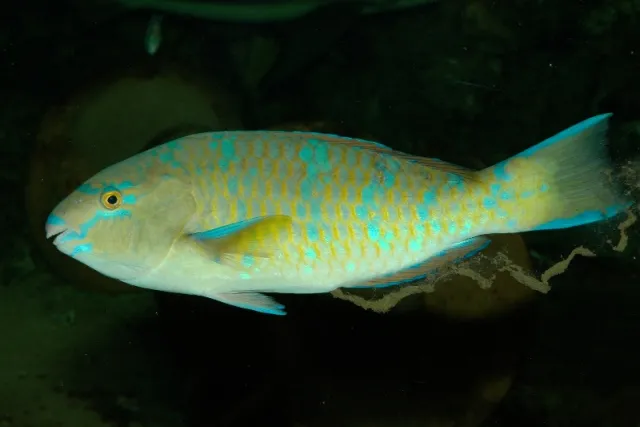
As far as parrotfish is concerned, the checkerboard pattern in their body formed by their highly developed scales, is unique in every species.
For example, you can easily identify a blue-barred parrotfish through its distinct yellow and blue colored checkerboard. Despite this alternate mix of colors, 2 or more vertical blue bars will float out from the sequence.
A Reef Scratcher
If you were able to closely observe the coral reefs of Cocos Island, you will wonder why some coral heads has some scratch markings. Do not be alarmed as this is not done by divers who are trying to etch their names or leave a marking as a souvenir of their underwater adventure which happened in the Philippines and other Asian countries.
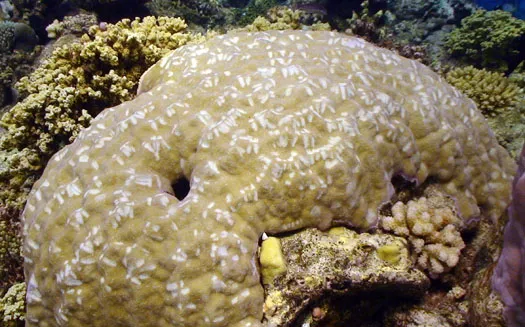
The Culprit? The Parrotfish of course, but they are doing it not to etch their species name or mark a territory. The reason behind this has something to do with feeding. While algae is a part of a parrotfish diet, micro-algal growth in corals is one of their favorite meal. They feed on this tiny algae by scraping off the surface of a live coral head leaving behind a white-colored scar technically termed as fish bite. If a single coral head is unfortunate enough, it may suffer several bite where you can see numerous scars in just a single coral colony.
Before we end this article, we urge you, just in case in your next dive adventures especially in Cocos Island, if you see someone (other than a parrotfish) etching or scratching coral heads for whatever reason, to take action by preventing further destruction to our reef system. You can talk to that person after your dive that what he did was wrong and convince him to support reef conservation by following the proper diving etiquette. After all, taking a nice underwater photograph will say a thousand words and is much better than etching on the surface of a coral head the words: I WAS HERE.
Reference
Fishbase: www.fishbase.org
IUCN Redlist of Threatened Species: www.iucnredlist.org
Wikipedia: en.wikipedia.org
Video courtesy from Won Chea